

A wholesale hand tools supplier checklist helps importers avoid quotations that look comparable but describe different products. If specifications remain vague, a low price can hide material substitutions, inconsistent heat treatment, or missing services. I use a structured checklist to align requirements before buyers approve samples, audits, or bulk orders.
A wholesale hand tools supplier checklist should verify that every quotation covers the same material, heat treatment, dimensions, finish, packaging, inspection criteria, and price inclusions. It should also examine how the supplier will transfer approved sample requirements into mass production through written specifications, process controls, traceability, and batch-level quality records.
I treat the checklist as a risk-screening tool rather than a simple questionnaire. In my experience handling hand-tool inquiries, quotations, samples, and order communication, the most useful answers are measurable and documented. The following checks help buyers identify weak assumptions before those assumptions become production problems.
How Should a Wholesale Hand Tools Supplier Checklist Align Quotations?
Several suppliers can quote a “heavy-duty” wrench, plier, or striking tool while calculating prices from different constructions. The descriptions may sound similar, but the underlying steel, dimensions, treatments, tolerances, and packaging may differ. I therefore align the technical and commercial scope before comparing unit prices.
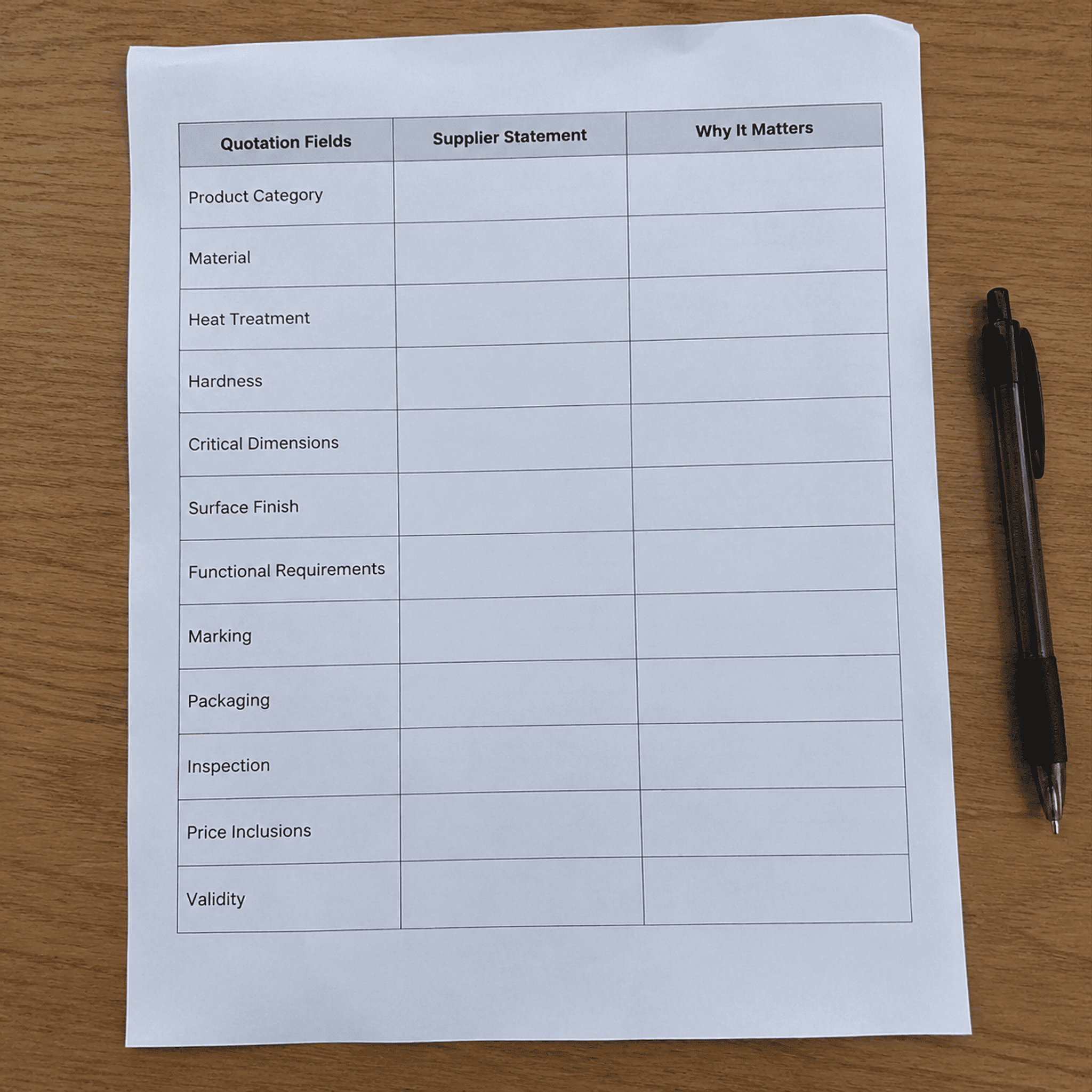
A wholesale hand tools supplier checklist should place competing quotations in one table and require each supplier to complete the same fields. Buyers should compare steel designation, heat-treatment method, application-specific hardness requirements, dimensions, finish, packaging, acceptance criteria, testing responsibility, and price inclusions. Blank or noncommittal fields should trigger clarification.
I start with a quotation-alignment table
I often see RFQs that contain a photo, a general size, and a target quantity. That information may be enough for an indicative price, but it is rarely enough for a reliable commercial comparison.1 A supplier may quote an existing standard model, while another supplier may include custom forging, tighter tolerances, or retail packaging.
I recommend building a table like this:
| Quotation field | What I ask suppliers to state | Why it matters |
|---|---|---|
| Product category and model | Exact tool type, size, pattern, and intended use | Similar-looking tools may have different constructions |
| Material | Written steel designation or agreed material specification | Labels such as “alloy steel” are not measurable enough |
| Heat treatment | Process used, treated areas, and control method | Different parts may require different treatment |
| Hardness | Target, tolerance, test method, and test location | One hardness value may not represent the entire tool |
| Critical dimensions | Nominal values and tolerances | Weight or overall length alone may hide functional differences |
| Surface finish | Coating, polishing, plating, paint, or other treatment | Finish affects appearance, corrosion behavior, and cost2 |
| Functional requirements | Load, torque, cutting, gripping, or impact criteria as applicable | Each tool category requires different evaluation |
| Marking | Brand, size mark, country-of-origin mark, warnings, and traceability code | Marking affects compliance and identification |
| Packaging | Unit package, inner quantity, carton specification, and labels | Packaging differences can materially change quotations |
| Inspection | Sampling plan, test items, and acceptance limits | “Inspection included” does not define acceptance |
| Price inclusions | Tooling, testing, packaging, freight term, and documentation | Buyers need a consistent landed-cost comparison |
| Validity and assumptions | Quote validity, exchange assumptions, and exclusions | Hidden conditions can change the final order value |
I do not accept material labels as complete specifications
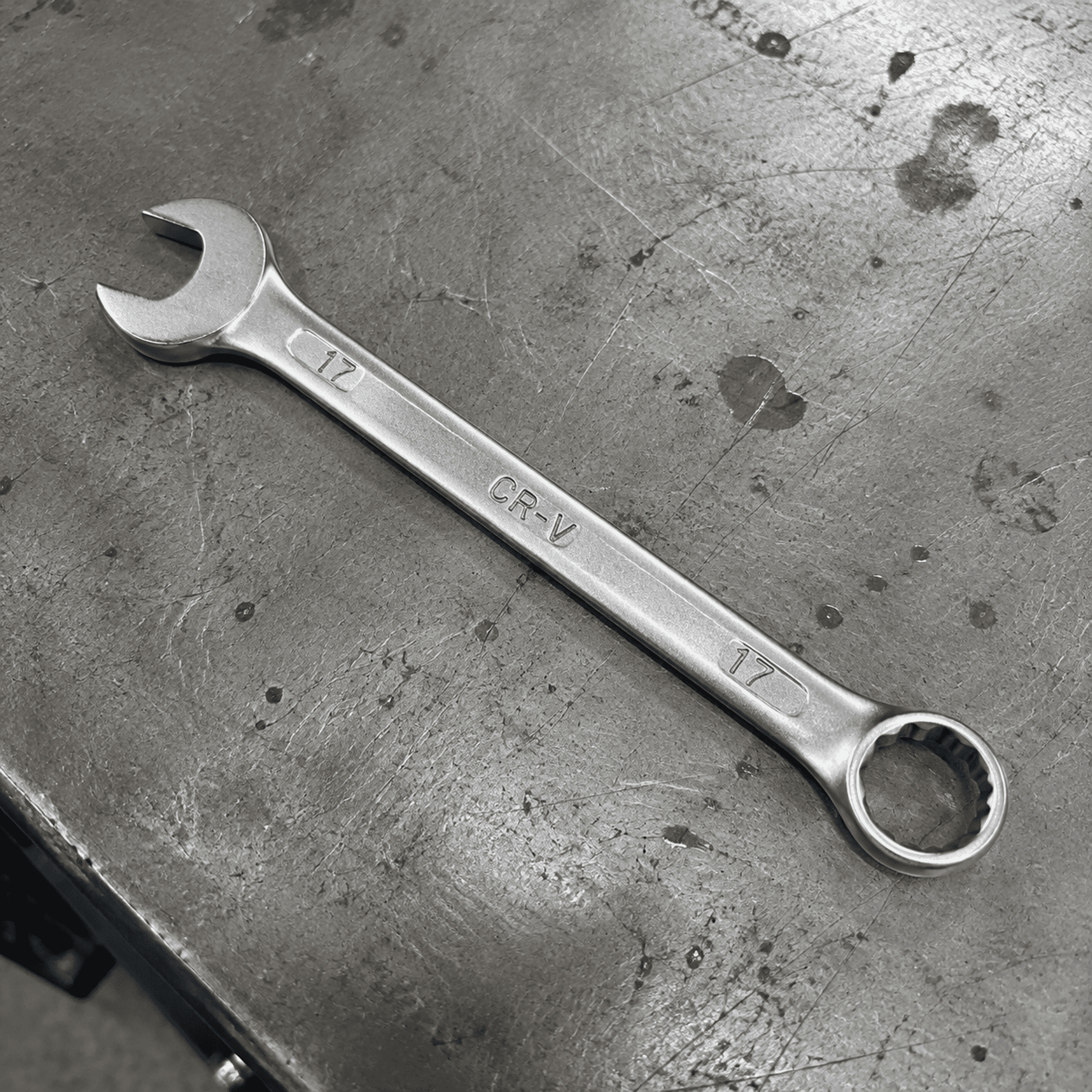
Terms such as “Cr-V,” “carbon steel,” “drop forged,” or “industrial grade” can provide a starting point, but they do not define a finished product. A broad material label does not confirm a specific grade, chemical composition, heat-treatment outcome, or performance level.3
I ask the supplier to connect each claim to verifiable requirements. For example:
- Which material designation appears on the purchase specification?
- Does an applicable standard define the material or performance?
- Which component uses that material?
- Which test method will confirm the requirement?
- Will the requirement apply to every batch or only the initial sample?
- Who will retain material and inspection records?
I do not impose one steel grade on every category. A pipe wrench, cutting plier, chain wrench, screwdriver, and hammer perform different tasks. The appropriate material and process depend on the tool design, intended use, applicable market requirements, and agreed test method.4
I compare prices only after I can explain the technical reason for the price difference.
This step does not guarantee quality. However, it prevents buyers from treating unlike quotations as if they were equal.
Which Universal and Category-Specific Checks Should the Checklist Include?
A generic questionnaire may miss the features that control the performance of a particular tool. At the same time, a highly technical product sheet may overlook basic supplier controls. I separate my wholesale hand tools supplier checklist into a universal layer and a category-specific layer.
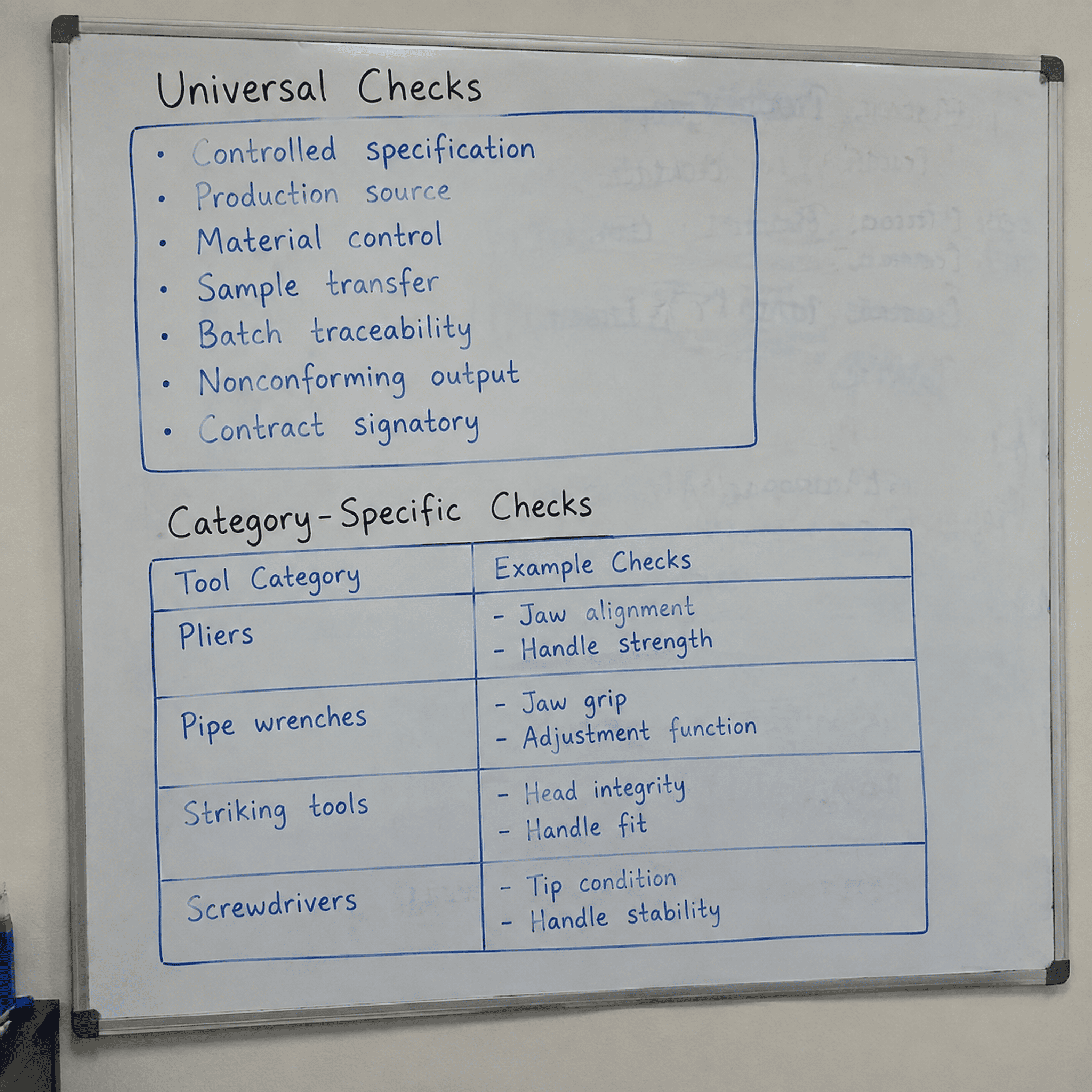
The universal layer should cover written specifications, revision control, sample transfer, batch traceability, inspection, corrective action, and legal-entity verification. The category-specific layer should cover the functional characteristics of each tool, such as jaw geometry, cutting-edge treatment, gripping performance, impact areas, adjustment mechanisms, or load-bearing components.
I apply universal checks to every product
Universal controls show whether the supplier can manage an approved requirement through purchasing, production, inspection, and shipment. I normally include the following questions:
-
Does the supplier issue a controlled specification?
I ask for a document number, revision level, date, and approval record.5 -
Can the supplier identify the production source?
I want clear disclosure about whether the product comes from a company-owned facility or a partner factory. -
How does the supplier control purchased materials?
I ask how receiving staff match incoming materials to the approved specification. -
How does the supplier transfer sample requirements?
I look for drawings, approved samples, process sheets, packaging instructions, and inspection plans. -
Can the supplier trace a shipment to a production batch?
I ask which records connect raw material, processing, inspection, packing, and shipment. -
How does the supplier handle nonconforming output?
I look for segregation, disposition approval, rework controls, and corrective-action records. -
Who signs the contract and assumes responsibility?
I compare the quotation, invoice, bank beneficiary, certificate holder, production site, and export entity.
I adapt technical checks to the tool category
I never treat one hardness range or test plan as correct for all hand tools. Buyers should define requirements with a qualified engineer, testing laboratory, or other competent professional when product safety or application-specific performance is involved.
The following examples show how the category layer can change:
| Tool category | Possible category-specific checks |
|---|---|
| Pliers and cutters | Cutting-edge geometry, body and edge treatment, pivot movement, handle fit, cutting test |
| Pipe wrenches | Jaw tooth geometry, jaw movement, frame dimensions, adjustment mechanism, gripping test |
| Striking tools | Head material, striking-face treatment, handle attachment, balance, impact-related inspection |
| Screwdrivers | Tip geometry, shaft material, tip treatment, handle retention, torque-related requirements |
| Chain or strap wrenches | Chain or strap specification, connection strength, handle construction, gripping range |
| Pipe stands and vises | Load-bearing components, welding or casting quality, stability, clamping function, rated-use verification |
| Tool storage products | Material thickness, hinges, latches, drawer operation, load distribution, coating |
For pliers, for example, a single hardness statement may be inadequate because the cutting edge and tool body can have different functional needs. For striking tools, the test location and applicable requirement matter as much as the reported value. I ask suppliers to define these details rather than offer a broad claim.
In our supplier team, we handle selected tool products through our own manufacturing capabilities and source other categories through qualified partner factories. I disclose that distinction during evaluation because buyers need to know where process control occurs. I also explain who owns the specification, who performs inspection, and who is contractually accountable.
How Should a Wholesale Hand Tools Supplier Checklist Evaluate Samples?
An attractive sample can create false confidence. A sample may receive extra attention, use selected material, or pass through a process that is difficult to repeat at scale. I therefore treat sample approval as the start of process verification, not as proof that every production unit will match.6
A wholesale hand tools supplier checklist should connect the approved sample to controlled production documents. Buyers should ask how the supplier will manage material batches, process parameters, first-piece approval, test locations, sampling ratios, inspection equipment, nonconforming products, and batch reports throughout mass production.
I approve a defined configuration, not just a physical object
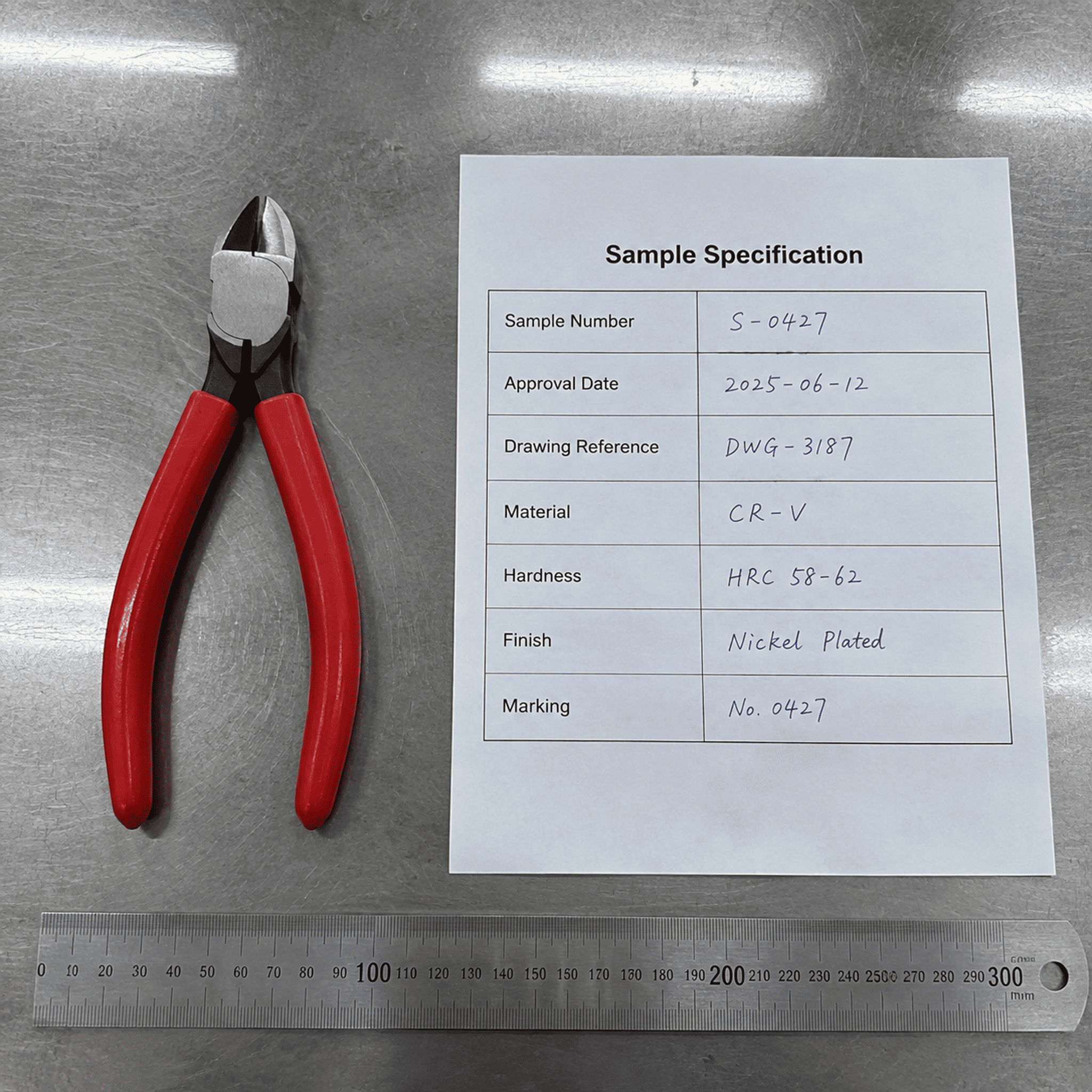
When I coordinate samples, I try to attach the sample to a written specification. The specification may include:
- A drawing or dimension sheet
- An approved material requirement
- A finish and color reference
- Product weight, where relevant
- Functional acceptance criteria
- Marking artwork and positioning
- Packaging construction and labels
- Approved deviations
- Photographs with identifying details
- A sample number and approval date
Without these records, two teams can interpret “same as the sample” differently. A physical sample can also become worn, damaged, misplaced, or confused with another version.
I recommend sealing or identifying retained samples when practical. The buyer and supplier should retain matching references. However, the written requirements should remain the primary communication tool.
I ask how the production process preserves the requirements
The right questions vary by process. Buyers may need to examine forging, casting, machining, stamping, welding, heat treatment, grinding, coating, assembly, or packaging. I focus on the steps that influence critical characteristics.
For heat-treated components, I may ask:
- How does the factory identify the incoming material batch?
- Which heat-treatment parameters are controlled?
- Does the factory process the part internally or through a subcontractor?
- How does the factory control quenching and tempering?
- Where does the inspector test hardness?
- Which method and equipment does the inspector use?
- How often does the inspector perform the test?
- What happens when a result falls outside the agreed tolerance?
- Can the supplier connect the report to the shipment batch?
I do not treat a hardness reading alone as proof of suitability. The reading must relate to the correct part, location, surface condition, method, and intended requirement.7 Product design and other performance tests may also matter.
I use production checkpoints
A practical sample-to-production plan can contain several gates:
- Pre-production review: The supplier confirms the latest drawings, specifications, packaging, and approved changes.
- Incoming-material review: The factory checks material identity and supplier documents against purchase requirements.
- First-piece approval: The factory measures and tests initial output before full production continues.
- In-process inspection: The quality team checks critical characteristics at defined intervals.
- Final inspection: Inspectors use agreed sampling and acceptance rules before shipment.
- Batch documentation: The supplier retains or submits reports linked to the order and production lot.
I once received an inquiry in which the buyer’s sample comments existed only in an email chain. The sourcing staff understood them, but the production documents did not contain the same details. That situation reinforced my view that sample comments must reach the people who purchase materials, set machines, inspect output, and pack cartons.
How Should Buyers Verify Traceability, Certificates, and Legal Entities?
Supplier presentations can combine factory photographs, trading-company details, partner-factory records, and certificates from different entities. The relationships may be legitimate, but unclear ownership creates risk. I use a wholesale hand tools supplier checklist to identify who manufactures, who inspects, who exports, and who accepts contractual responsibility.
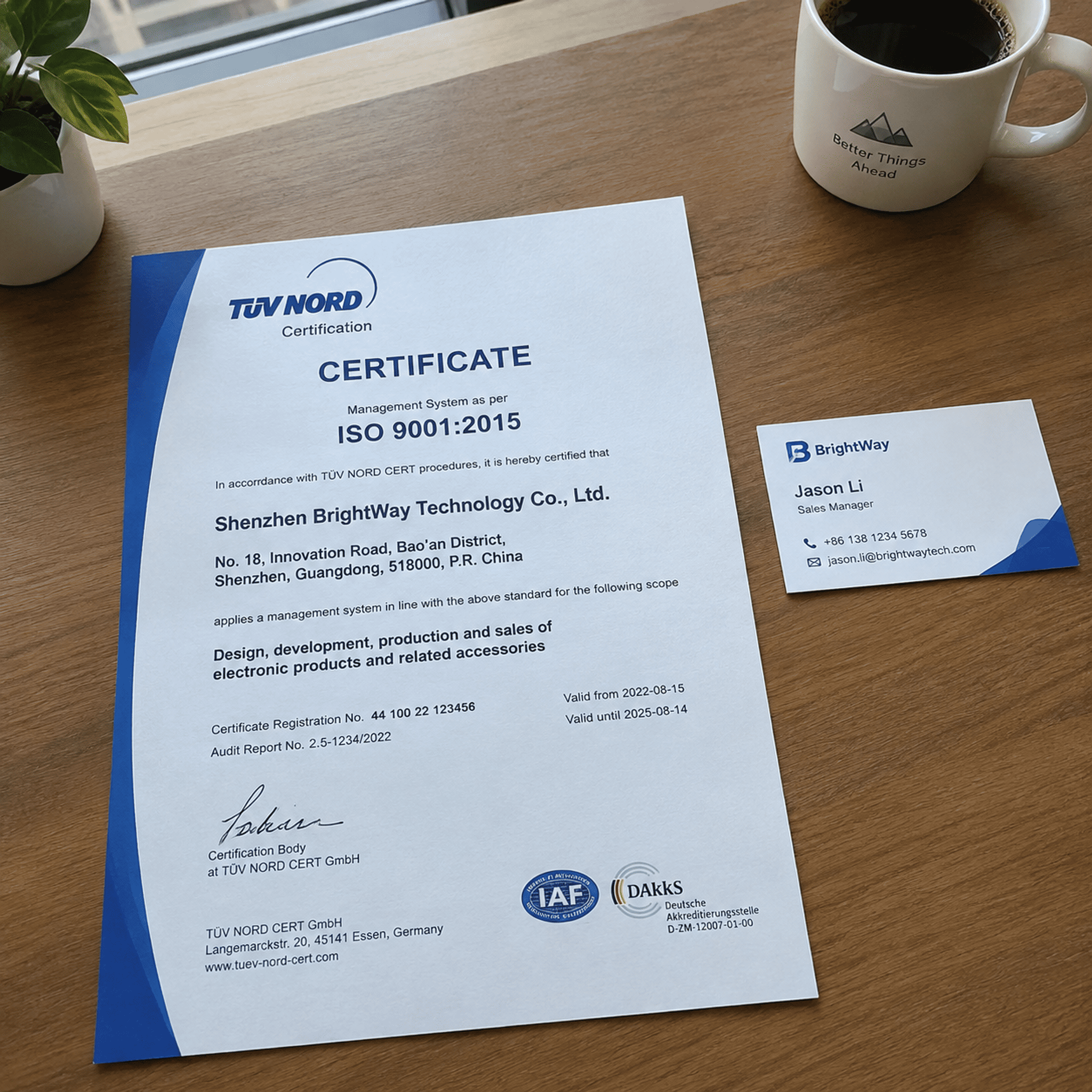
Buyers should compare the legal names and addresses on quotations, contracts, invoices, bank details, audit reports, and certificates. They should verify certificate validity, scope, site coverage, and issuer independently. A certificate can support due diligence, but it does not replace product specifications, testing, or production controls.8
I map the parties before relying on documents
A hand-tool supply arrangement can involve several organizations:
- The contracting seller
- The product manufacturer
- A heat-treatment subcontractor
- A coating or plating provider
- A packaging factory
- An inspection company
- An exporter
- A certificate holder
Multiple parties do not automatically indicate a problem. Many capable supply chains use specialized partners. The risk appears when the supplier cannot explain the relationships or refuses to document responsibility.
I ask for a simple supply-chain map. It should show:
- Where the main production steps occur
- Which entity purchases critical materials
- Which entity controls the specification
- Which entity performs incoming and final inspection
- Which subcontracted processes affect key characteristics
- Which company appears on the sales contract
- Which company handles complaints and corrective actions
I treat certifications as documents to verify
I do not present a management-system certificate as proof that every shipment meets product requirements. The certificate may indicate that an audited management system falls within a defined scope, but buyers should still confirm the following:
- Legal name: Does it match the claimed organization?
- Site address: Does it cover the actual production location?
- Scope: Does it relate to the relevant manufacturing activity?
- Validity dates: Is the certificate current?
- Certification body: Is the issuer identifiable and appropriate?
- Database status: Can the buyer verify the record through the issuer or relevant database?
- Relationship: If another entity holds the certificate, how does that entity relate to the order?
I recommend requesting clarification when the certificate holder differs from the contracting party. A group relationship, affiliated factory, or manufacturing partner may explain the difference. Still, the supplier should disclose that relationship in writing.
I define useful batch traceability
Traceability does not always require serializing every low-cost hand tool. The appropriate level depends on risk, product type, order structure, and buyer requirements. At minimum, I want a practical link between the shipment and its production records.9
A traceability chain might connect:
Purchase order → material lot → production batch → inspection report → packaging lot → shipment
The supplier should explain how long it retains records and how quickly it can retrieve them. If a complaint occurs, the supplier should be able to identify affected batches rather than treating every historical shipment as suspect.
For application-specific or regulated decisions, I recommend that buyers consult qualified compliance professionals and accredited testing resources. Our supplier team can organize specifications, samples, inspections, and supporting documents, but we do not replace an independent laboratory, certification body, or metallurgical authority.
Which Supplier Answers Are Red Flags on a Wholesale Hand Tools Supplier Checklist?
Procurement risk often appears in the way a supplier answers questions. A supplier may offer a competitive price and polished catalogue yet avoid measurable commitments. I listen for specific explanations, document references, and clear ownership instead of relying on confidence, speed, or broad quality claims.
Red flags include vague material descriptions, refusal to confirm specifications in writing, unexplained entity differences, missing test locations, and no process for transferring sample requirements to production. Stronger suppliers explain assumptions, identify responsible parties, disclose sourcing arrangements, and propose verification when an answer requires technical confirmation.
I distinguish incomplete answers from evasive answers
A supplier may not know every detail during an initial inquiry. I do not expect a sales representative to answer an application-specific metallurgical question immediately. I do expect the representative to identify the correct technical contact, investigate the issue, and return with a documented response.
I consider these answers relatively constructive:
- “We need to confirm that requirement with the heat-treatment facility.”
- “Our standard model uses one specification, but we can quote your alternative after reviewing the test method.”
- “This category comes from our partner factory. We remain the contracting supplier and will provide the factory details for your audit.”
- “The certificate belongs to the production entity rather than our export entity. We can document the relationship.”
- “Your acceptance criterion is not clear yet. Please confirm the test location and applicable standard.”
These statements do not prove capability, but they expose assumptions and create a path to verification.
I treat the following responses as warning signs:
- “All our tools are industrial grade.”
- “The material is Cr-V, so there is no need for more detail.”
- “The sample passed, so production will be the same.”
- “Our certificate is valid, but we cannot provide a verifiable copy.”
- “The factory name is confidential, even after commercial qualification.”
- “We cannot add the approved requirements to the purchase specification.”
- “Quality depends on the customer’s target price.”
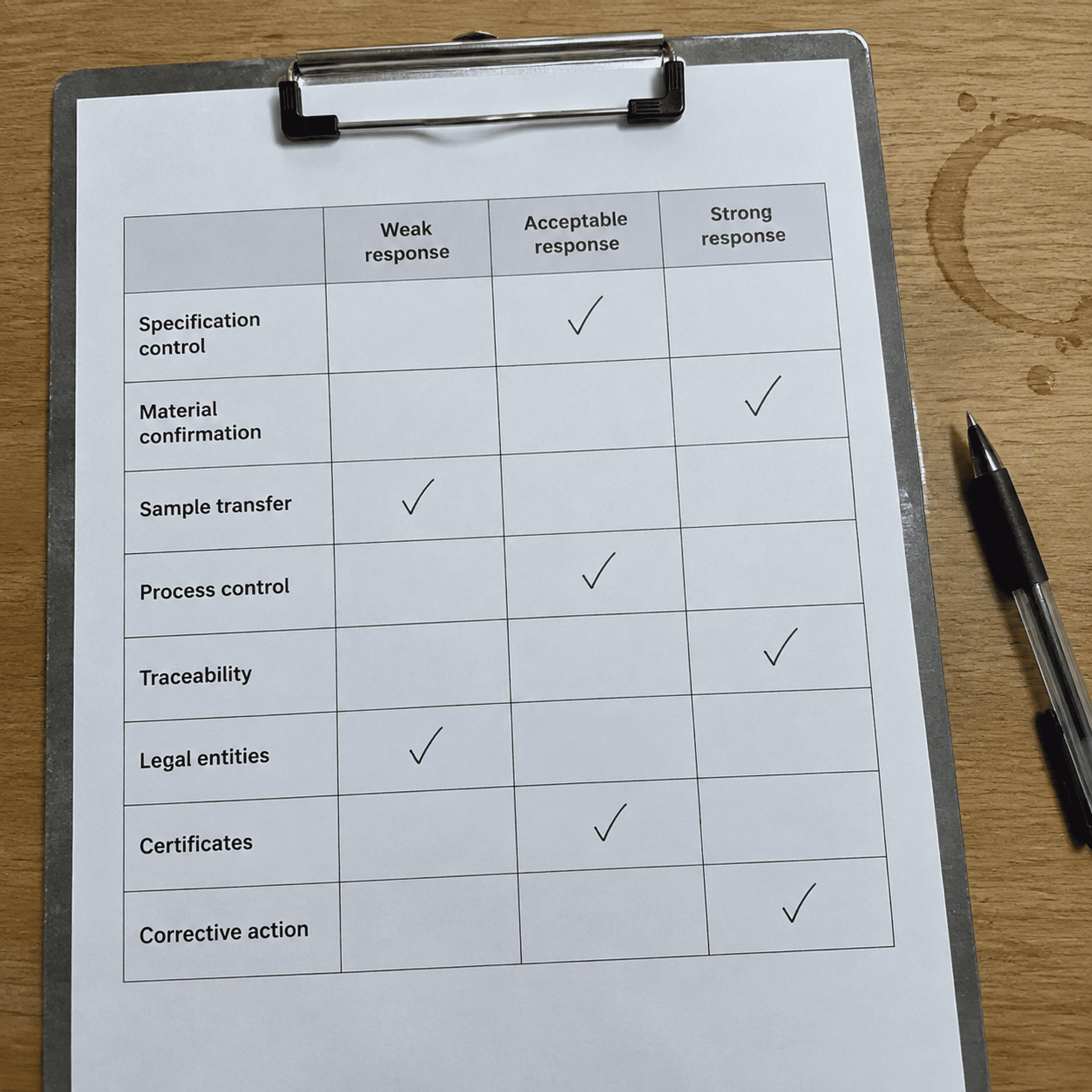
I score evidence, not presentation quality
I use a simple scorecard to make supplier screening less subjective:
| Evaluation area | Weak response | Acceptable response | Strong response |
|---|---|---|---|
| Specification control | Verbal description | Basic written specification | Controlled document with revisions and approvals |
| Material confirmation | General material family | Written designation | Designation plus batch-linked verification plan |
| Sample transfer | “Same as sample” | Sample reference | Sample, drawings, process sheet, and inspection criteria linked |
| Process control | General QC claim | Basic inspection steps | Defined checkpoints, responsibilities, and records |
| Traceability | Order number only | Production date or lot | Material, production, inspection, and shipment links |
| Legal entities | Unexplained differences | Relationship explained | Relationship documented with clear accountability |
| Certificates | Image in presentation | Verifiable valid document | Verified scope and site plus relevance explained |
| Corrective action | Replacement promise | Complaint process | Containment, root-cause review, action, and effectiveness check |
I use the scorecard before investing heavily in factory audits, custom tooling, or repeated sample rounds. Buyers can weight each area according to risk. For example, a custom load-bearing tool may require more technical and process scrutiny than a basic tool-storage accessory.
A complete wholesale hand tools supplier checklist should not become a pass-or-fail form based on marketing claims. It should help the buyer decide which statements need documents, which requirements need testing, and which risks require an audit or qualified technical review.
Frequently Asked Questions
What information should I send before requesting a hand-tool quotation?
I recommend sending the tool category, intended use, dimensions, material or performance requirements, finish, branding, packaging, quantity, destination, inspection expectations, and applicable standards. If some details remain open, I mark them clearly so suppliers can state their assumptions instead of silently choosing a cheaper configuration.
Is an approved hand-tool sample enough to place a bulk order?
No. I treat an approved sample as one part of the production specification. Buyers should also confirm drawings, materials, critical tolerances, finishes, test methods, packaging, process checkpoints, and acceptance criteria. The supplier should explain how it will reproduce and verify those requirements during mass production.
Should I reject a supplier that uses partner factories?
Not automatically. I evaluate whether the supplier discloses the production source, controls specifications, performs or arranges inspection, manages corrective actions, and accepts contractual responsibility. Our own integrated manufacturing-and-trading model also distinguishes products handled through direct manufacturing capabilities from products sourced through qualified partner factories.
How can I verify a hand-tool supplier’s quality certificate?
I compare the legal name, site address, scope, issue date, expiry date, and certification body with the claimed production operation. I also seek independent verification through the issuer or relevant database. I do not use a certificate as a substitute for product testing, batch records, or factory evaluation.
When should I arrange a factory audit or independent inspection?
I consider an audit when order value, customization, product risk, or uncertainty justifies deeper process review. I consider independent inspection when buyers need impartial shipment verification. Neither activity corrects a vague specification, so I define measurable requirements and acceptance criteria before arranging either service.10
Conclusion
A wholesale hand tools supplier checklist should establish whether suppliers quoted the same configuration and whether they can reproduce approved requirements in bulk. I focus on written specifications, category-specific criteria, sample-to-production controls, traceability, legal-entity consistency, and verifiable documents—not unit price alone. Ridgimax supports wholesalers and importers with hand-tool sourcing, product development, OEM/ODM coordination, sampling, and order communication across our manufacturing capabilities and partner-factory network. Contact our team to review your RFQ and build a quotation-alignment checklist for your required hand-tool range.
"Technical Specifications", https://documents1.worldbank.org/curated/en/099710507092534067/pdf/IDU-2f5f55a5-f19b-41cb-bf5e-601fd69cce52.pdf. Institutional procurement guidance states that technical specifications should define requirements clearly enough for suppliers to prepare responsive offers and for purchasers to evaluate bids on a common basis; this supports the need for more detail than a photograph, nominal size, and quantity, although it does not prescribe a hand-tool-specific RFQ format. Evidence role: general_support; source type: institution. Supports: Clear, complete, and nonambiguous technical specifications provide a common basis for preparing and evaluating competing bids.. Scope note: The guidance applies broadly to procurement and does not directly test quotation accuracy in the hand-tool industry. ↩
"Coatings for corrosion protection", https://nvlpubs.nist.gov/nistpubs/Legacy/SP/nistspecialpublication1035.pdf. Corrosion-engineering literature explains that coatings and surface treatments can change a metal surface's appearance and resistance to environmental attack by providing a barrier or modifying surface behavior; associated cost effects are process-dependent rather than uniform. Evidence role: mechanism; source type: paper. Supports: Coatings and other surface treatments can form barriers or alter surfaces to reduce corrosion, and different finishing processes entail different processing requirements.. Scope note: The source can directly support the corrosion mechanism but may provide only contextual support for cost, which varies with finish type, production volume, and local pricing. ↩
"Heat treatment and properties of iron and steel", https://nvlpubs.nist.gov/nistpubs/legacy/mono/nbsmonograph88.pdf. Metallurgical references distinguish broad steel families from individual grades with specified composition ranges and explain that heat treatment alters microstructure and mechanical properties; a family label alone therefore cannot establish the exact material condition or finished-tool performance. Evidence role: mechanism; source type: education. Supports: Steel-family terminology encompasses materials with different compositions, while heat treatment changes the resulting microstructure and mechanical properties.. ↩
"MULTI-OBJECTIVE OPTIMIZATION IN MATERIAL DESIGN ...", https://stuff.mit.edu/afs/athena/course/4/4.464/www/MultiObjectiveOptimization-Ashby.pdf. Engineering materials-selection literature treats function, design constraints, loading, service environment, and manufacturing process as interdependent inputs to material choice; this supports category-specific selection rather than prescribing one steel or process for every hand tool. Evidence role: expert_consensus; source type: paper. Supports: Engineering materials selection evaluates material properties and processes against product function, design constraints, loading, environment, and manufacturing requirements.. Scope note: General materials-selection literature does not establish the correct specification for any particular wrench, plier, screwdriver, or striking tool. ↩
"RPD Control of quality system documentation", https://www.nist.gov/document/guide02v310pdf. ISO 9001 document-control principles require documented information to be suitably identified and controlled, including review and authorization of changes; document numbers, revision levels, dates, and approval records are common implementations of those principles. Evidence role: general_support; source type: institution. Supports: Quality-management standards require documented information to be appropriately identified, reviewed, approved, protected, and controlled when changed.. Scope note: ISO 9001 establishes control objectives but does not mandate this exact set of fields for every hand-tool specification. ↩
"Checking the Net Contents of Packaged Goods", https://www.nist.gov/system/files/documents/2023/02/10/2023%20NIST%20Handbook%20133.pdf. Statistical quality-control guidance explains that production output varies and that lot-level conclusions require a defined sampling or process-control framework; approval of one selected sample therefore cannot by itself establish conformity of every later production unit. Evidence role: mechanism; source type: government. Supports: Manufacturing processes exhibit variation, and conclusions about a production lot require an appropriate sampling or process-control basis rather than inspection of a single selected unit.. ↩
"Rockwell hardness measurement of metallic materials", https://nvlpubs.nist.gov/nistpubs/Legacy/SP/nistspecialpublication960-5.pdf. NIST hardness-measurement guidance identifies test method, surface condition, specimen geometry, indentation placement, and instrument performance as factors affecting the validity and comparability of hardness results; the reported number must therefore be tied to defined test conditions and location. Evidence role: mechanism; source type: government. Supports: Hardness measurements are method-dependent and can be affected by surface preparation, specimen geometry, indentation placement, and instrument conditions.. ↩
"ISO - Certification", https://www.iso.org/certification.html. ISO and accreditation guidance distinguish management-system certification from product certification: an ISO 9001 certificate concerns the organization's quality-management system and does not certify that a particular product or shipment conforms to specified technical requirements. Evidence role: definition; source type: institution. Supports: Management-system certification assesses an organization's management system within a stated scope and is distinct from certification or testing of individual products.. ↩
"Metrological Traceability: Frequently Asked Questions and ...", https://www.nist.gov/metrology/metrological-traceability. Quality-management terminology defines traceability as the ability to follow an object's history, application, or location, while ISO 9001 requires retention of documented information needed for traceability where traceability is a requirement; linking a shipment to production and inspection records is consistent with that principle. Evidence role: definition; source type: institution. Supports: Traceability is the ability to follow the history, application, or location of an item through recorded identification and process information.. Scope note: The appropriate traceability depth and retention period depend on contractual, regulatory, and product-risk requirements. ↩
"Technical Specifications", https://documents1.worldbank.org/curated/en/099710507092534067/pdf/IDU-2f5f55a5-f19b-41cb-bf5e-601fd69cce52.pdf. Conformity-assessment standards define inspection as examination followed by a determination of conformity with specified requirements; where requirements and acceptance criteria are vague, an audit or inspection lacks a complete objective basis for deciding conformity. Evidence role: mechanism; source type: institution. Supports: Conformity assessment determines whether specified requirements have been fulfilled, so meaningful inspection depends on requirements that are defined in advance.. Scope note: Audits may still reveal process or governance weaknesses, but they cannot independently determine product acceptability when the purchaser has not defined the relevant criteria. ↩

Leave a Reply