
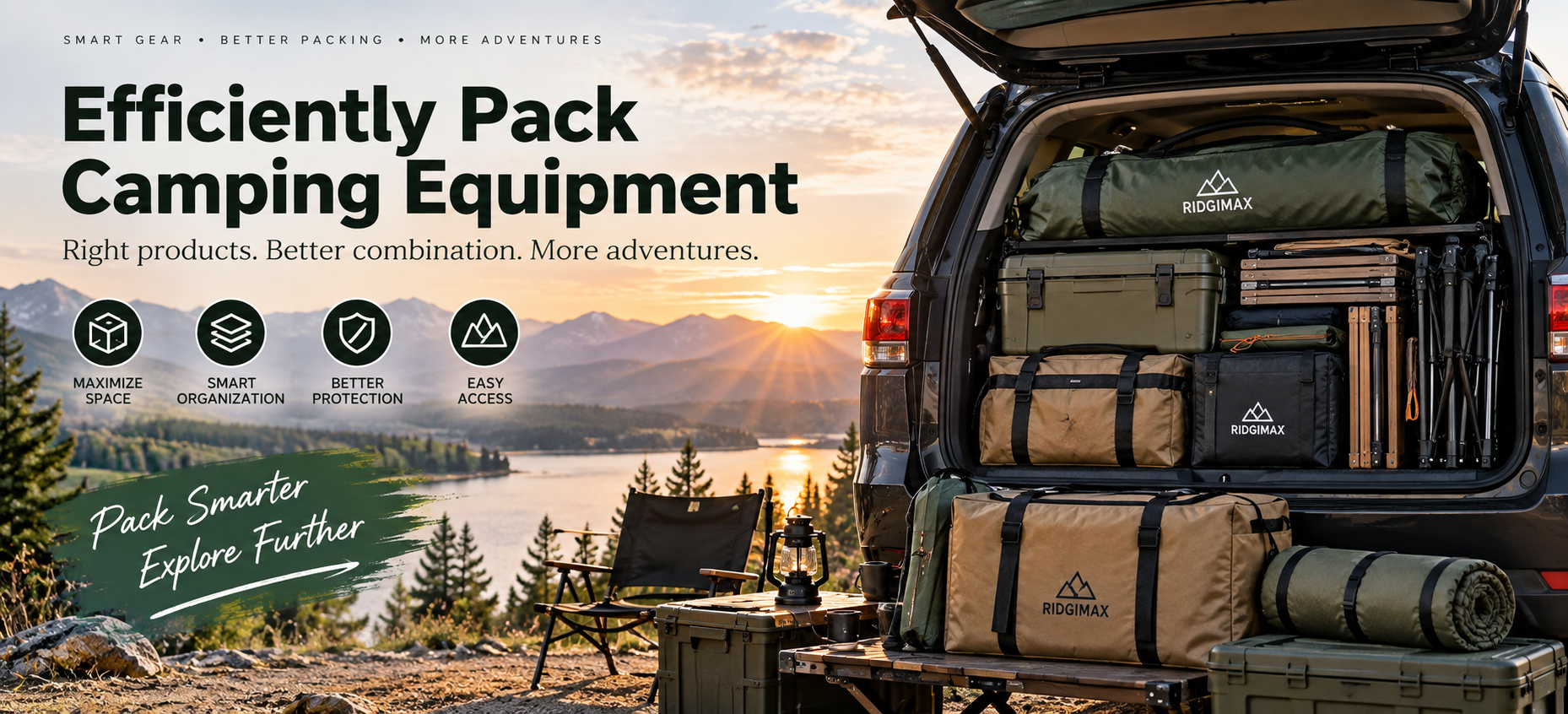
Packing camping equipment efficiently often becomes difficult before anyone opens a vehicle trunk or shipping carton. Products can look compact on their own but create gaps, unstable stacks, and poor access when combined. I solve this problem by evaluating folded dimensions, shape compatibility, storage structures, and retrieval order during product selection and development.
To pack camping equipment efficiently, I select products according to their folded dimensions, shape regularity, stackability, and order of use. I then evaluate the full kit as one system. The best assortment minimizes unusable gaps, avoids unnecessary storage layers, protects vulnerable components, and keeps frequently needed items accessible without unloading everything else.
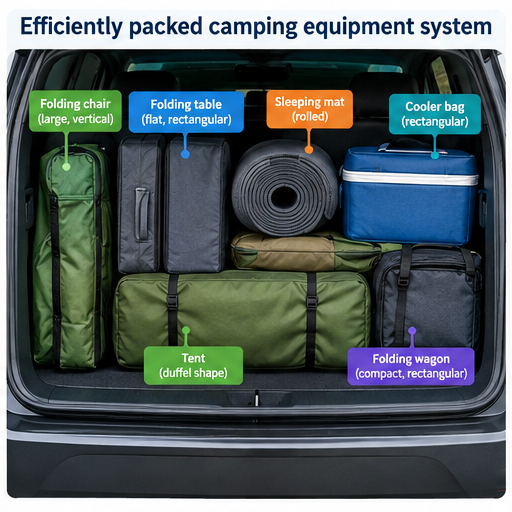
This approach shifts the discussion from “How small is each item?” to “How well does the entire assortment work together?” For outdoor brand owners and product managers, that distinction can influence product specifications, packaging decisions, perceived quality, and the practical value of a coordinated camping range.
What Does Efficient Camping Equipment Packing Mean for a Product Assortment?
Many product teams define packability as minimum folded volume. That definition is too narrow. A small product can still be awkward to load, difficult to identify, or incompatible with the rest of the kit. If buyers evaluate only isolated samples, those problems may remain hidden until the assortment reaches the market.
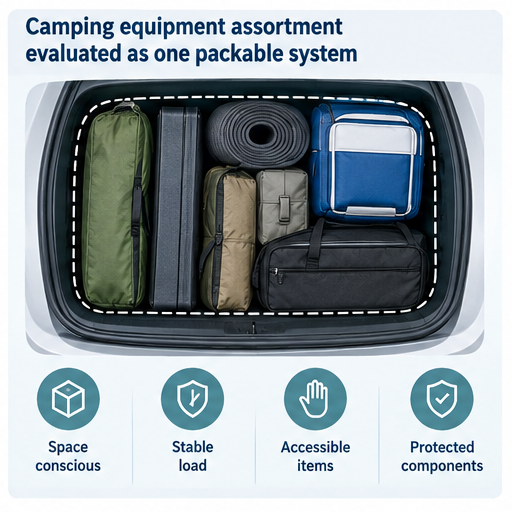
I define efficient camping equipment packing as the ability to arrange a complete kit into a stable, space-conscious, and accessible load. The evaluation should consider folded volume, external shape, stackability, storage-bag bulk, component protection, and retrieval sequence. No single measurement can describe the performance of the whole system.
I Start With the System, Not the Individual Product
During product selection, I often see an item described as “compact” because it folds into a visually small package. That description may be accurate in isolation. However, the product can still perform poorly beside a folding table, camping chair, sleeping mat, cot, cooler bag, or folding wagon.
For example, a round bundle may have a low total volume but leave curved gaps when placed beside rectangular products.1 A long, narrow chair may fit along one side of a vehicle but interfere with the loading direction of a folded table. A thick carry-bag handle can also prevent two otherwise flat products from stacking securely.
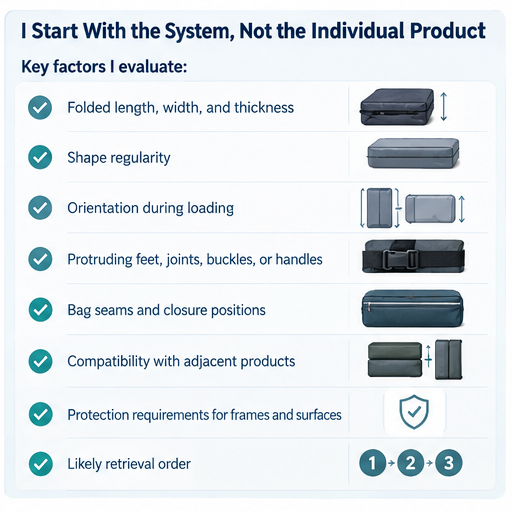
I therefore review several dimensions of packability:
- Folded length, width, and thickness
- Shape regularity
- Orientation during loading
- Protruding feet, joints, buckles, or handles
- Bag seams and closure positions
- Compatibility with adjacent products
- Protection requirements for frames and surfaces
- Likely retrieval order
A Practical Product-Side Evaluation
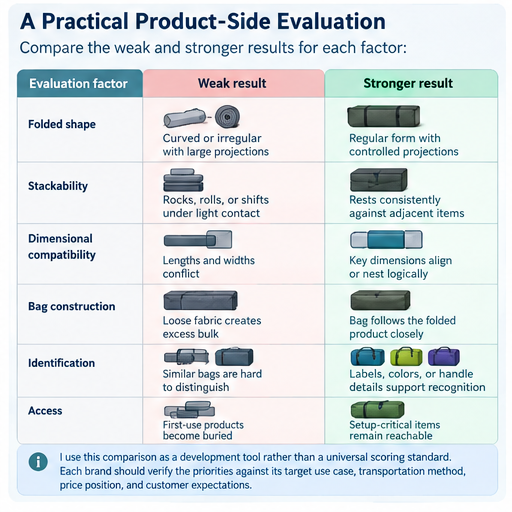
I recommend that procurement teams create a simple loading model before approving a coordinated assortment. The model does not need to simulate every consumer situation. It only needs to reveal obvious conflicts between the products.
| Evaluation factor | Weak result | Stronger result |
|---|---|---|
| Folded shape | Curved or irregular with large projections | Regular form with controlled projections |
| Stackability | Rocks, rolls, or shifts under light contact | Rests consistently against adjacent items |
| Dimensional compatibility | Lengths and widths conflict | Key dimensions align or nest logically |
| Bag construction | Loose fabric creates excess bulk | Bag follows the folded product closely |
| Identification | Similar bags are hard to distinguish | Labels, colors, or handle details support recognition |
| Access | First-use products become buried | Setup-critical items remain reachable |
I use this comparison as a development tool rather than a universal scoring standard. Each brand should verify the priorities against its target use case, transportation method, price position, and customer expectations.
A compact product is not automatically a packable product. I judge the spaces between products as carefully as I judge the products themselves.
How Do Folded Dimensions Help Pack Camping Equipment Efficiently?
Outdoor products are usually presented in their open form because that is how customers use them. Procurement decisions, however, should also examine the folded form. If a specification sheet omits one folded dimension or ignores protruding parts, buyers cannot reliably assess how the product will fit into a complete kit.
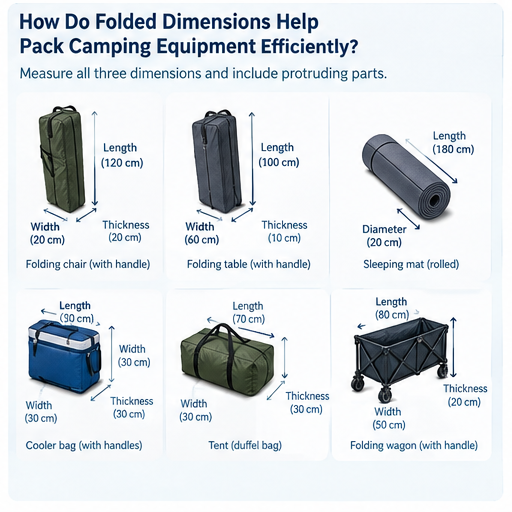
To pack camping equipment efficiently, I compare all three folded dimensions and record the true outer envelope, including handles, feet, hinges, buckles, and bagged components. I also examine whether the folded product keeps its stated shape under normal handling. A nominal measurement has limited value if loose parts regularly extend beyond it.
Nominal Size Versus Practical Outer Envelope
A supplier may list a folded chair as a simple length-by-width measurement. That information does not always show the maximum thickness at the frame joints. It may also exclude a shoulder strap, cord lock, or loose fabric section.
I prefer to evaluate the practical outer envelope. This envelope is the smallest rectangular space that contains the complete packed product in its normal storage condition.2 The method helps product managers compare products with different structures.
I ask suppliers or development teams to clarify:
- Does the folded measurement include the carry bag?
- Does it include detachable parts?
- Where is the thickest point?
- Do frame tubes remain parallel after folding?
- Can straps or handles be secured against the bag?
- Does the product maintain its folded form without manual compression?
- Are the measurements based on an approved production sample?
These questions are simple, but they can expose differences between a visually compact prototype and a repeatable production specification.
Shape Regularity Matters
Rectangular products often stack predictably, but shape alone does not determine quality. A rectangular table with exposed hinges can damage adjacent textile products.3 A cylindrical chair bag may fit well beside a cooler if the dimensions are coordinated. I therefore avoid treating one shape as universally superior.
Instead, I assess how regularly the shape repeats across production and how the product interacts with other items. For example:
- Flat products can form a stable base, but they may be hard to retrieve when buried.
- Long products can use narrow side spaces, but they may restrict loading direction.
- Cylindrical products can fill certain channels, but they may roll without restraint.4
- Soft products can fill gaps, but excessive compression may affect padding or construction.5
- Irregular metal frames may nest together, but contact points require protection.
When developing camping equipment, I also consider whether a minor design change could improve packability without harming function. A repositioned handle, flatter buckle, restrained strap, or revised bag pattern can make the folded form easier to combine with other products.
I do not assume that the smallest possible dimensions are always best. Stronger frame structures, adequate padding, and usable handles can justify additional volume. The goal is a balanced specification that supports handling, protection, and efficient loading.
Why Should I Evaluate Camping Equipment as a Complete System?
Product catalogs encourage item-by-item comparison. Customers, however, often transport several products together. A folding chair, table, cot, sleeping mat, picnic blanket, cooler, and wagon can each pass an individual review while still creating an inefficient combined load.
I evaluate camping equipment as a system because packability depends on dimensional relationships between products.6 I look for aligned lengths, complementary shapes, stable stacking surfaces, and shared loading logic. This process identifies wasted gaps and access conflicts that isolated product inspections cannot reveal.
Individually Compact Products Can Conflict
I once reviewed a combination in which every individual product appeared easy to store. When I placed their folded specifications side by side, the assortment had several incompatible lengths and bulky closure points. No single item caused the problem. The inconsistency across the range caused it.
This pattern appears frequently during product development. Different factories may optimize products according to their existing tooling, packaging, or component supply. Those decisions can be reasonable at the item level. However, they may create an assortment without a common dimensional logic.
Brand owners can reduce this risk by establishing a packability architecture. This architecture can define preferred dimensional relationships without forcing every item into an identical shape.
For example, a product manager might specify that:
- Folded chair lengths should remain compatible with the chosen table format.
- Sleeping products should fit above or beside the hard-frame products.
- Soft coolers should have a stable base and controlled side-wall expansion.
- Picnic mats should fold into dimensions that fill predictable gaps.
- Small accessories should consolidate without creating many loose bags.
- Folding wagons should accommodate selected products when appropriate to the intended use.
These are development directions, not fixed universal rules. I recommend confirming each relationship through approved samples and a representative loading review.
I Use a Compatibility Matrix
A compatibility matrix helps me compare products before final selection. The matrix can remain simple:
| Product pairing | Key question | Potential design response |
|---|---|---|
| Table and chairs | Do folded lengths align? | Adjust bag orientation or product dimensions |
| Cot and sleeping mat | Can the mat sit securely beside or above the cot? | Revise straps or folded width |
| Cooler and picnic mat | Can the mat fill a gap without blocking access? | Change fold sequence or handle position |
| Wagon and full kit | Does the intended assortment fit safely inside? | Review internal dimensions and wheel intrusion |
| Metal frame and textile bag | Can hard points cause abrasion? | Add localized reinforcement or separation |
The matrix also supports supplier communication. Instead of asking whether an item is “easy to pack,” I can provide the dimensions and constraints of the related products. The supplier can then evaluate specific contact points, orientation, and storage features.
For bulk procurement, I advise buyers to verify dimensional information through pre-production or production samples. Buyers should also define measurement methods in their quality documents. If packability is commercially important, the inspection criteria should state where and how folded dimensions are measured.
Do More Bags Help Pack Camping Equipment Efficiently?
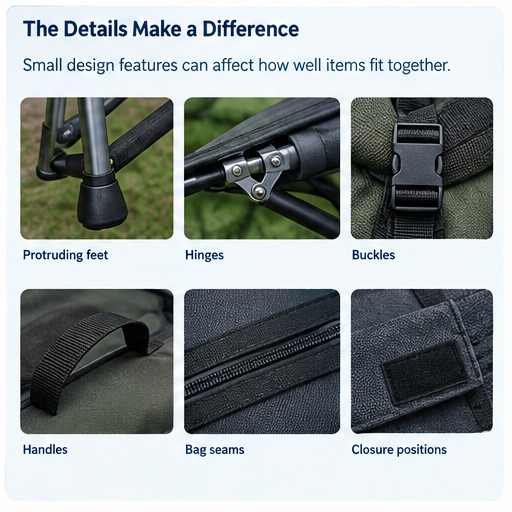
Extra storage bags can create an immediate impression of organization. That impression does not always survive practical evaluation. Every bag adds fabric, seams, closures, labels, handles, and potential empty space.7 Several small bags can also become harder to identify and manage than a controlled number of well-designed storage units.
More bags do not automatically help pack camping equipment efficiently. A useful bag should control the product’s folded shape, protect relevant components, support handling, and enable identification. If it only adds another packaging layer, it may increase bulk and complexity without improving access or organization.
I Evaluate the Purpose of Every Storage Layer
I ask one question for each proposed bag or compartment: What specific problem does it solve?
A bag can provide real value when it:
- Prevents folded components from opening
- Contains detachable parts
- Protects nearby products from hard or sharp contact points
- Keeps dirt or moisture away from other items after appropriate use
- Provides a practical carrying handle
- Helps users identify the product
- Maintains a regular outer shape
A bag provides less value when it loosely surrounds the item, duplicates an existing layer, or adds decorative compartments without a clear access function.
I also examine the bag pattern. Excess fabric can gather around frame ends and make a package wider than necessary. A drawstring closure may be simple, but the gathered material can create a bulky top. A full-length zipper may create a cleaner shape, but it introduces different cost, durability, and manufacturing considerations.
The correct decision depends on the product. I do not recommend one closure for every type of camping equipment.
Compartments Can Improve or Reduce Access
Compartments are useful when they correspond to a clear retrieval need. For example, a dedicated location for table connectors or removable feet can prevent loose parts from moving through a larger bag. However, an internal divider can also restrict how a flexible product settles into available space.
I compare storage options according to practical criteria:
| Storage approach | Possible advantage | Possible drawback |
|---|---|---|
| Individual bag for every item | Clear separation | More layers, labels, and loose units |
| Shared accessory pouch | Fewer small bags | Contents may become mixed |
| Integrated pocket | Accessory remains with product | Pocket can increase folded thickness |
| Compression straps | Controls loose volume | May complicate packing or stress materials |
| Structured bag | Regular outer form | Added weight, cost, and fixed volume |
| Soft close-fitting bag | Low structural bulk | Less protection and shape control |
Product managers should also consider replacement and after-sales needs. If an essential part is stored in a removable pouch, the pouch attachment should be evaluated carefully. If a carry bag is central to the product’s packability, its fabric, stitching, handles, and closures should be included in quality inspections.
I recommend checking storage features on physical samples rather than approving them only from drawings. Fabric behavior, seam allowance, and component placement can alter the final packed shape in ways that two-dimensional specifications do not show.8
How Does Retrieval Order Help Pack Camping Equipment Efficiently?
A perfectly dense load can still be inconvenient if the first required product sits at the bottom. Users may need a wagon, chair, table, shelter component, or waterproof item before they need sleeping products. If the assortment ignores this sequence, customers must unload and reload the kit.
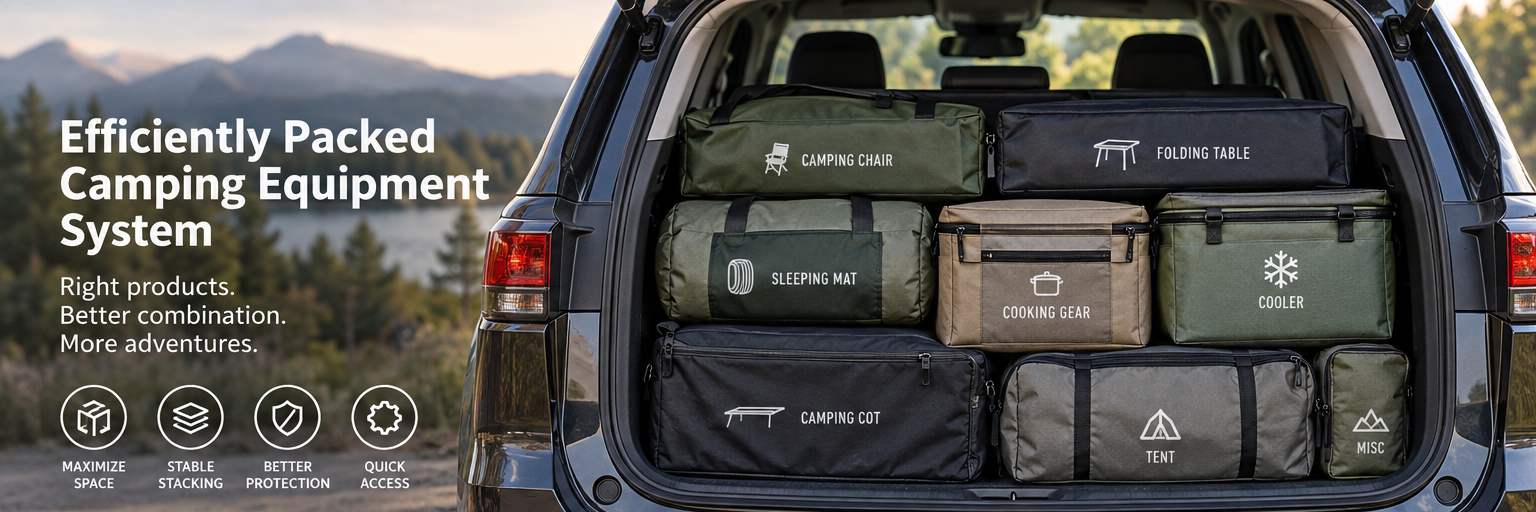
Retrieval order helps pack camping equipment efficiently by assigning accessible positions to setup-critical and frequently used products.9 I group items by when they are likely to be needed, then balance access against weight, stability, and protection. Efficient packing should reduce unnecessary handling rather than maximize density at any cost.
I Design Around Access Zones
I find it useful to divide a packed system into three conceptual access zones:
- Immediate-access zone: Products needed during arrival, unloading, or initial setup.
- Secondary-access zone: Products used after the main site or area is established.
- Low-frequency zone: Backup items or products needed later in the use sequence.
This model is not a universal camping instruction. It is a product-development framework. Each outdoor brand should define likely retrieval sequences for its own product positioning and customer group.
For example, a folding wagon may need to remain accessible because it can help transport the rest of the kit. A table or chair may also be used early. Sleeping mats and cots may be retrieved later. However, the intended environment, vehicle type, and product concept can change this sequence.
Density, Stability, and Access Must Work Together
Access cannot override every other requirement. Heavy products should not be placed in unstable positions merely because users may need them first.10 Hard metal frames should not rest against vulnerable fabrics without protection. A cooler may require a level orientation depending on its construction and contents.
I use the following questions to balance these needs:
- Which products are likely to be removed first?
- Can those products be reached from the primary loading opening?
- Does removing one item destabilize the remaining stack?
- Do handles face an accessible direction?
- Can users identify bags without opening them?
- Do straps, wheels, or frame ends catch on nearby products?
- Can the kit be repacked in a logical sequence?
- Are vulnerable surfaces protected throughout loading and retrieval?
Handle placement deserves special attention. A carry handle can appear comfortable during an isolated product review but face the wrong direction once the item is loaded beside other products. I therefore review handle access in the intended packed orientation.
Visual identification can also improve retrieval without adding bulky compartments.11 Brands can use controlled methods such as woven labels, printed product names, color accents, or different handle details. These features should fit the brand system and remain clear after production.
For commercial development, I recommend creating a sample loading plan with photographs and orientation notes. The plan can support internal product reviews, supplier discussions, packaging development, and marketing accuracy. It should not replace application-specific evaluation, but it can reveal whether the assortment’s storage logic is coherent.
How Should Buyers Evaluate a Camping Equipment Supplier’s Packability Capabilities?
A supplier may manufacture each item correctly while lacking experience in coordinated assortment development. That gap can lead to inconsistent folded dimensions, unrelated bag structures, and avoidable compatibility problems. Buyers therefore need to assess more than catalog breadth or isolated sample appearance.
I evaluate a camping equipment supplier by reviewing its ability to provide complete folded specifications, revise storage structures, coordinate products across categories, control approved dimensions, and communicate design trade-offs. I also verify these capabilities through samples, technical documents, quality plans, and production inspection rather than relying only on sales claims.
Questions I Recommend Asking Suppliers
Procurement teams can ask focused questions during supplier qualification:
- Can the supplier provide bagged and unbagged folded dimensions?
- Can the supplier explain the maximum outer envelope?
- Can it revise handles, straps, bag patterns, or closure locations?
- Can it compare a new item against other products in the assortment?
- How does it control folded dimensions during production?
- Which dimensional tolerances are practical for the materials and structure?
- Can it produce coordinated samples for a loading review?
- How are specification changes recorded and approved?
- Which inspections cover carry bags, straps, closures, and labels?
I also look at how a supplier responds to conflicts. A capable development partner should not simply promise the minimum size. The supplier should explain when a smaller package could affect frame design, fabric stress, ease of folding, protection, or manufacturing consistency.
Verification Remains Essential
Buyers should treat specifications, test reports, and certifications as documents that require verification. The relevance of a document depends on the product, target market, claimed standard, issuing body, date, and scope.12 Packability itself may not be covered by a conventional certification, so buyers need clear specifications and agreed inspection methods.
For application-specific performance or regulatory decisions, I recommend consulting qualified testing, compliance, or engineering professionals. A loading review can identify dimensional and access issues, but it does not establish structural safety, load capacity, material compliance, or transport suitability.
At Ridgimax, I approach outdoor product development through coordinated product selection, OEM/ODM discussions, sample review, and specification alignment. I believe the strongest supplier conversations begin with the buyer’s assortment goals rather than a vague request for “more compact” products. That approach gives both parties clearer criteria for evaluating trade-offs.
Frequently Asked Questions
Is the smallest folded size always best for camping equipment?
No. I compare folded size with structural design, protection, handling, shape regularity, and compatibility. An extremely compressed product may be harder to fold, less stable in a stack, or more vulnerable to damage. The best specification balances compactness with reliable production and practical use.
Which folded dimensions should a product manager request?
I recommend requesting folded length, width, and maximum thickness in the final storage condition. The specification should clarify whether measurements include the carry bag, handles, straps, feet, hinges, and detachable parts. Buyers should also define the measurement method and verify dimensions on approved samples.
Should every item have its own carry bag?
No. I use a separate carry bag only when it improves shape control, protection, handling, part containment, or identification. A loose or unnecessary bag can add bulk and create another item to manage. Each storage layer should have a clear product-side purpose.
How can brands test whether an assortment packs well together?
I recommend assembling representative approved samples and loading them into a defined reference space. The team should record product orientation, unused gaps, contact points, handle access, retrieval sequence, and stack stability. Buyers should repeat the review after relevant design or packaging changes.
Can one packing design work for every market?
I would not assume so. Vehicle types, purchasing habits, product combinations, price positioning, and user expectations differ across markets. Brands should define their intended scenarios and ask qualified professionals to assess application-specific safety, regulatory, or transport requirements where necessary.
Conclusion
Efficient camping equipment packing starts during product selection, not after production. I evaluate true folded dimensions, shape regularity, assortment compatibility, storage-bag purpose, and retrieval order as one connected system. I also verify the result through coordinated samples and clearly defined quality requirements instead of relying on compact-looking photographs or unsupported claims. If your brand is developing a more packable outdoor assortment, contact Ridgimax to discuss product selection, OEM/ODM options, storage structures, and sample-based compatibility evaluation.
"3 H3: 3D Hyperbolic Quasi-Hierarchical Graphs", https://graphics.stanford.edu/papers/munzner_thesis/html/node8.html. Elementary packing geometry shows that circular cross-sections do not tile a rectangular region without interstitial gaps, supporting the observation that round bundles can leave residual space beside rectilinear packages. Evidence role: mechanism; source type: education. Supports: Packing geometry demonstrates that curved boundaries generally leave interstitial spaces when circles or cylinders are arranged within rectangular regions.. Scope note: Idealized two-dimensional geometry does not quantify the actual unused volume in a mixed three-dimensional camping load. ↩
"Minimum bounding box", https://en.wikipedia.org/wiki/Minimum_bounding_box. In computational geometry, a bounding box is a rectangular enclosure containing an object or point set; this established concept provides the geometric basis for describing a packed product by its enclosing outer envelope. Evidence role: definition; source type: encyclopedia. Supports: The established concept of a bounding box or minimum bounding rectangle describes the smallest enclosing rectangular region for an object or point set.. Scope note: Formal definitions may permit an optimally rotated box, whereas a product specification may require measurements in a fixed storage orientation. ↩
"Quantitative Assessment of Woven Fabric Surface Changes ...", https://pmc.ncbi.nlm.nih.gov/articles/PMC12348827/. Textile abrasion and snagging research shows that localized rubbing and contact with hard or protruding surfaces can damage fibers and yarn structures, supporting separation or reinforcement at exposed hardware contact points. Evidence role: mechanism; source type: paper. Supports: Textile-wear research supports that repeated rubbing, localized pressure, and contact with protrusions can cause abrasion, yarn damage, or snagging.. Scope note: Laboratory abrasion and snag tests do not directly establish the damage rate for a particular table hinge, fabric, or transport environment. ↩
"11.1 Rolling Motion – University Physics Volume 1 - UCF Pressbooks", https://pressbooks.online.ucf.edu/osuniversityphysics/chapter/11-1-rolling-motion/. Classical mechanics describes how a cylindrical body can undergo rolling motion when torque or a component of gravity acts on it, which supports restraining cylindrical packages in a load. Evidence role: mechanism; source type: education. Supports: Physics treatments of rolling motion explain why cylindrical bodies can rotate and translate under an applied force or gravitational component unless constrained.. ↩
"[PDF] Assessment of Frequency and Amplitude Dependence on the Cyclic ...", https://tsapps.nist.gov/publication/get_pdf.cfm?pub_id=957161. Materials research on flexible foams and cushioning structures documents compression set and changes in thickness or mechanical response after sustained or repeated loading, indicating that heavy compression can affect some padded products. Evidence role: mechanism; source type: paper. Supports: Studies of flexible foams and cushioning materials document compression set, thickness loss, or altered mechanical response after sustained or repeated compression.. Scope note: The extent of change is material- and condition-specific, so the evidence does not show that ordinary packing pressure damages every soft camping product. ↩
"[PDF] Robot Packing with Known Items and Nondeterministic Arrival Order", http://motion.cs.illinois.edu/papers/RSS2019-Wang-RobotPackingNondeterministic.pdf. Research on three-dimensional bin-packing and container-loading problems shows that overall space utilization depends on the dimensions, orientations, and spatial compatibility of all items in a load, although these models do not directly measure consumer camping-kit convenience. Evidence role: general_support; source type: paper. Supports: Container-loading and three-dimensional bin-packing research supports evaluating items jointly because dimensions, orientations, and placement constraints affect total space utilization.. Scope note: The research generally concerns formal logistics and optimization problems rather than camping-equipment assortments. ↩
"Environmental Fact Sheet: Source Reduction of Municipal Solid Waste", https://nepis.epa.gov/Exe/ZyPURL.cgi?Dockey=10000M1Y.TXT. Packaging source-reduction guidance treats unnecessary layers and avoidable empty space as contributors to material use and package volume, supporting scrutiny of whether each separate storage bag performs a necessary function. Evidence role: general_support; source type: government. Supports: Packaging-minimization guidance recognizes that additional packaging layers increase material use and that avoidable empty space can reduce packaging efficiency.. Scope note: Such guidance addresses packaging systems generally and does not establish that an additional reusable carry bag is inefficient in every camping application. ↩
"Analysis of Woven Fabric Mechanical Properties in the ... - PMC", https://pmc.ncbi.nlm.nih.gov/articles/PMC12349057/. Research on fabric drape and three-dimensional garment construction shows that material properties, seams, and pattern geometry influence the realized shape of a sewn object, so a two-dimensional specification may not fully predict its packed form. Evidence role: mechanism; source type: paper. Supports: Textile-engineering research shows that fabric drape and mechanical properties, seams, and pattern construction influence the three-dimensional geometry of sewn products.. Scope note: Most published work focuses on garments or textile simulation rather than carry bags for camping equipment. ↩
"Rehandling-aware stowage planning for RoRo ships using ...", https://pmc.ncbi.nlm.nih.gov/articles/PMC12830674/. Studies of sequential and multi-drop loading model retrieval order as an accessibility constraint because poorly sequenced placement can require items to be moved before the intended cargo is reached. Evidence role: general_support; source type: paper. Supports: Sequential and multi-drop loading research treats unloading order and item accessibility as constraints that can reduce rehandling.. Scope note: Logistics models concern freight operations and provide contextual rather than direct evidence about campsite setup. ↩
"Cargo Securement Rules | FMCSA - Department of Transportation", https://www.fmcsa.dot.gov/regulations/cargo-securement/cargo-securement-rules. Government cargo-loading guidance emphasizes stable weight distribution, a suitably low center of gravity, and restraint against movement, supporting the avoidance of heavy items in elevated or otherwise unstable positions. Evidence role: expert_consensus; source type: government. Supports: Official load-securement guidance advises distributing weight to preserve stability, keeping the center of gravity appropriately low, and restraining cargo against movement.. Scope note: Commercial cargo-securement rules may not apply legally to private camping loads, though the underlying stability principles remain relevant. ↩
"The purpose of this guidance is to help human prescription ...", https://www.fda.gov/media/158522/download. Human-factors research on visual search indicates that distinctive color and labeling cues can improve target discrimination and shorten identification time when the coding system is consistent and readily visible. Evidence role: general_support; source type: paper. Supports: Visual-search and human-factors studies indicate that salient color and label cues can improve target discrimination and reduce search time under suitable conditions.. Scope note: The benefit depends on lighting, color contrast, user familiarity, visual ability, and the consistency of the coding scheme. ↩
"FAQs - Certification and Third Party Testing | CPSC.gov", https://www.cpsc.gov/Business--Manufacturing/Testing-Certification/Third-Party-Testing/FAQs-Certification-and-Third-Party-Testing-OLD. International conformity-assessment guidance requires test reports and certificates to be interpreted within their stated scope, including the identified product, referenced method or standard, issuing body, and validity information. Evidence role: expert_consensus; source type: institution. Supports: International accreditation and conformity-assessment guidance emphasizes checking the accredited body, applicable scope, referenced standard, identification of the tested product, and report or certificate status.. Scope note: The exact verification requirements vary by regulatory regime, accreditation program, product category, and target market. ↩



Leave a Reply