
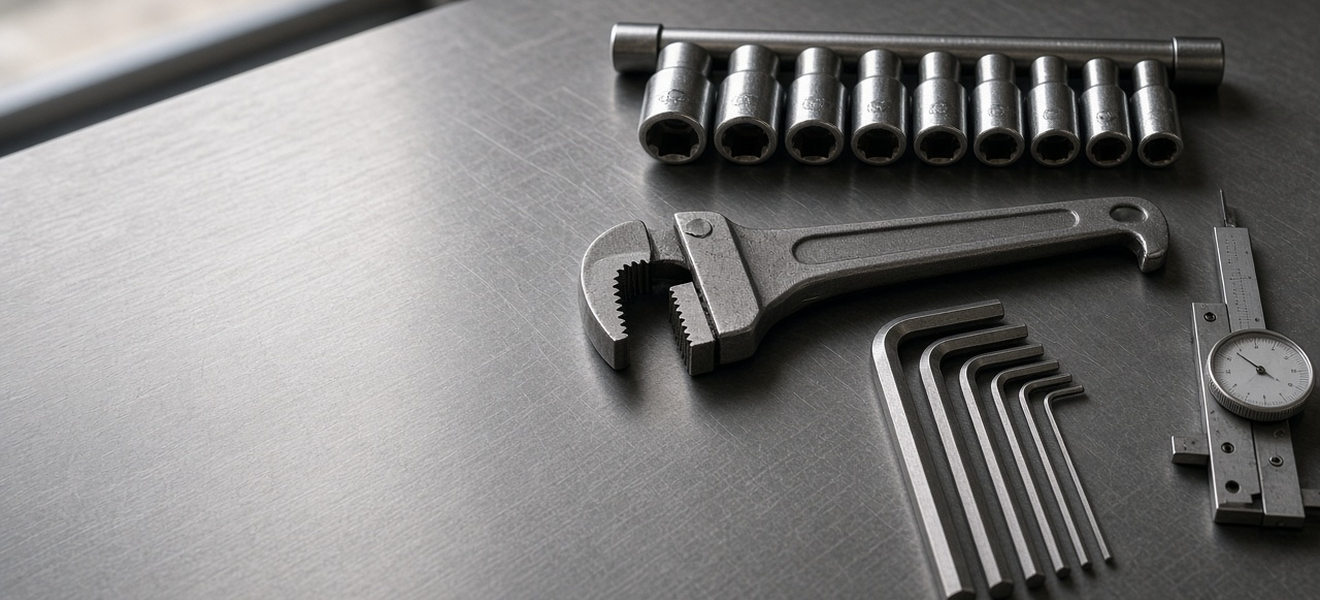
Hand tool safety often fails before a worker opens the package. If buyers select a tool by price, appearance, or a vague material label, instructions cannot correct the mismatch later. I reduce this risk by defining the task, construction requirements, inspection controls, maintenance rules, and retirement criteria before approving production.
General guidelines for hand tool safety begin with choosing the correct tool for the exact application. Buyers should document operating conditions, specify critical materials and construction, verify batch consistency, communicate misuse boundaries, and define inspection and retirement rules. PPE and user training remain important, but neither can compensate for a tool that was incorrectly specified or inconsistently manufactured.1
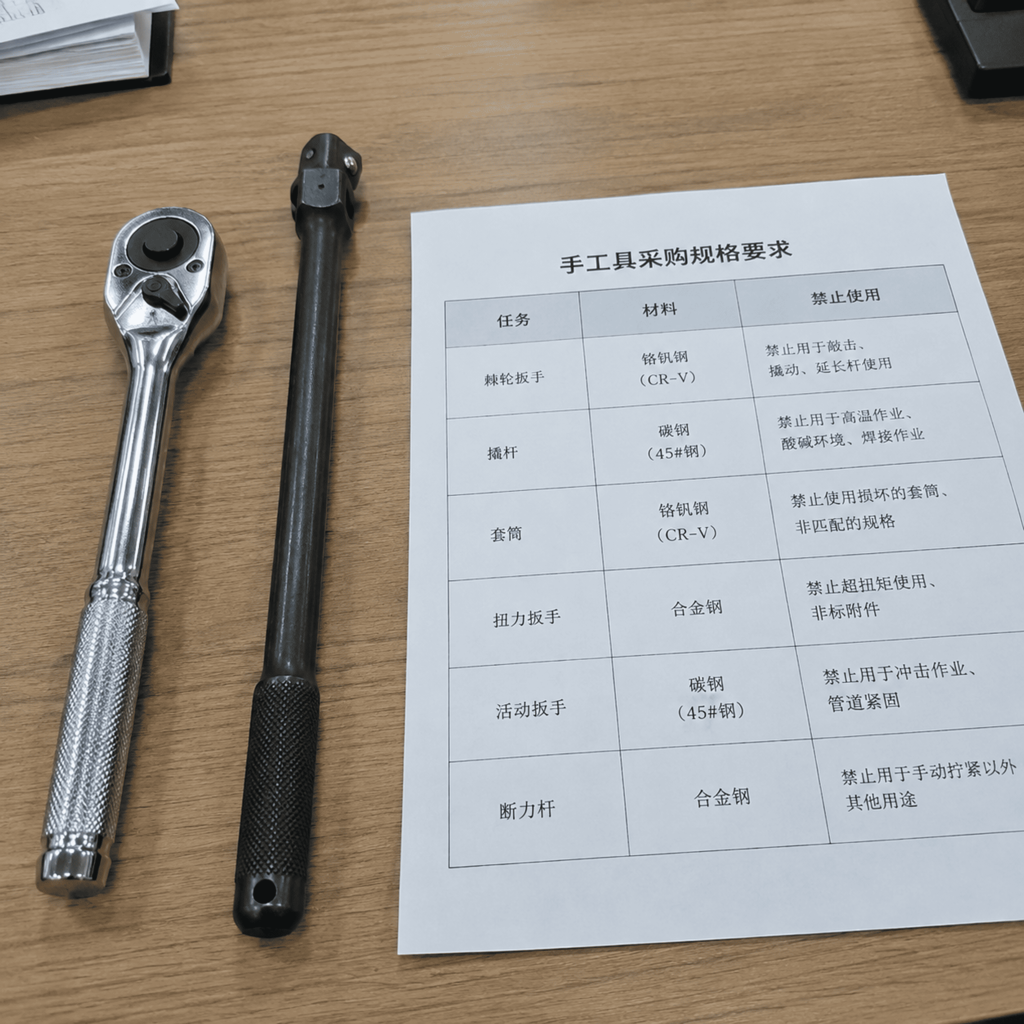
I approach safety as a closed procurement loop rather than a list of operating warnings. The loop starts with application analysis and continues through supplier selection, specification, production control, incoming inspection, user guidance, maintenance, and retirement.
How Does Task Definition Improve Hand Tool Safety?
Procurement teams sometimes request a familiar model without documenting how it will be used. That shortcut creates hidden risk because similar-looking tools can have different operating limits. I therefore define the workpiece, loading method, engagement point, dimensions, and prohibited uses before comparing quotations.
A clear task definition improves hand tool safety by matching the tool’s design to its real working conditions. The purchasing specification should identify manual or powered use, workpiece material and hardness, expected load direction, relevant dimensions, access limitations, and environmental conditions. It should also state applications that the tool must never perform.
Start With the Real Application
I usually begin a specification review with a basic question: What will the operator actually do with this tool? A catalogue name rarely provides enough information.
For example, a buyer may request a socket without clarifying whether it will be used with:
- A manual ratchet
- A breaker bar
- A torque wrench
- A pneumatic impact wrench
- An electric impact wrench
- An extension or universal joint
- Repeated high-load production work
A chrome-plated hand socket should not automatically be treated as an impact socket.2 Impact applications may require different materials, geometry, wall construction, heat treatment, markings, and validation methods. The exact requirements should come from the tool design, applicable standards, and qualified technical evaluation.
I apply the same reasoning to cutters. A cutting capacity for soft material does not establish suitability for hardened wire, cable, fasteners, or spring stock.3 Procurement teams should document the material type, approximate hardness, cross-section, and cutting frequency instead of specifying only a diameter.
Define Engagement and Loading Conditions
Hex keys provide another useful example. A ball end improves access when the tool cannot remain perfectly aligned. However, its reduced contact area can affect the load it can safely transmit.4 Buyers should not assume that straight-end tightening values also apply to ball-end engagement. The permitted use and torque conditions need confirmation from the design owner or manufacturer.
Pipe tools create a different specification problem. A nominal pipe size is not always the same as the actual outside diameter.5 I have seen product discussions become confusing because one party referred to the nominal system while another measured the workpiece directly.
A useful application brief can include the following fields:
| Procurement question | Information to document |
|---|---|
| How will the tool be driven? | Manual, impact, powered, or striking use |
| What will it contact? | Material, coating, hardness, shape, and surface condition |
| What dimensions matter? | Actual diameter, nominal size, thickness, and access space |
| How often will it be used? | Occasional, repeated, or production-cycle use |
| What load is expected? | Torque, tension, impact, cutting, or bending |
| What must be prohibited? | Extensions, hammering, powered use, or unsuitable materials |
| What rules apply? | Target-market regulations, standards, and customer requirements |
These details help suppliers recommend a suitable construction. They also make quotations easier to compare because each supplier responds to the same operating conditions.
I do not treat instructions as a substitute for correct product selection. A warning label cannot convert a hand socket into an impact socket or make a cutter suitable for hardened stock.
What Should a Hand Tool Safety Specification Include?
A vague specification leaves critical decisions to individual factories or production teams. Terms such as “premium,” “heavy duty,” “Cr-V,” and “industrial grade” can sound reassuring, but they do not define measurable performance. I replace broad descriptions with design-specific requirements that can be inspected or verified.
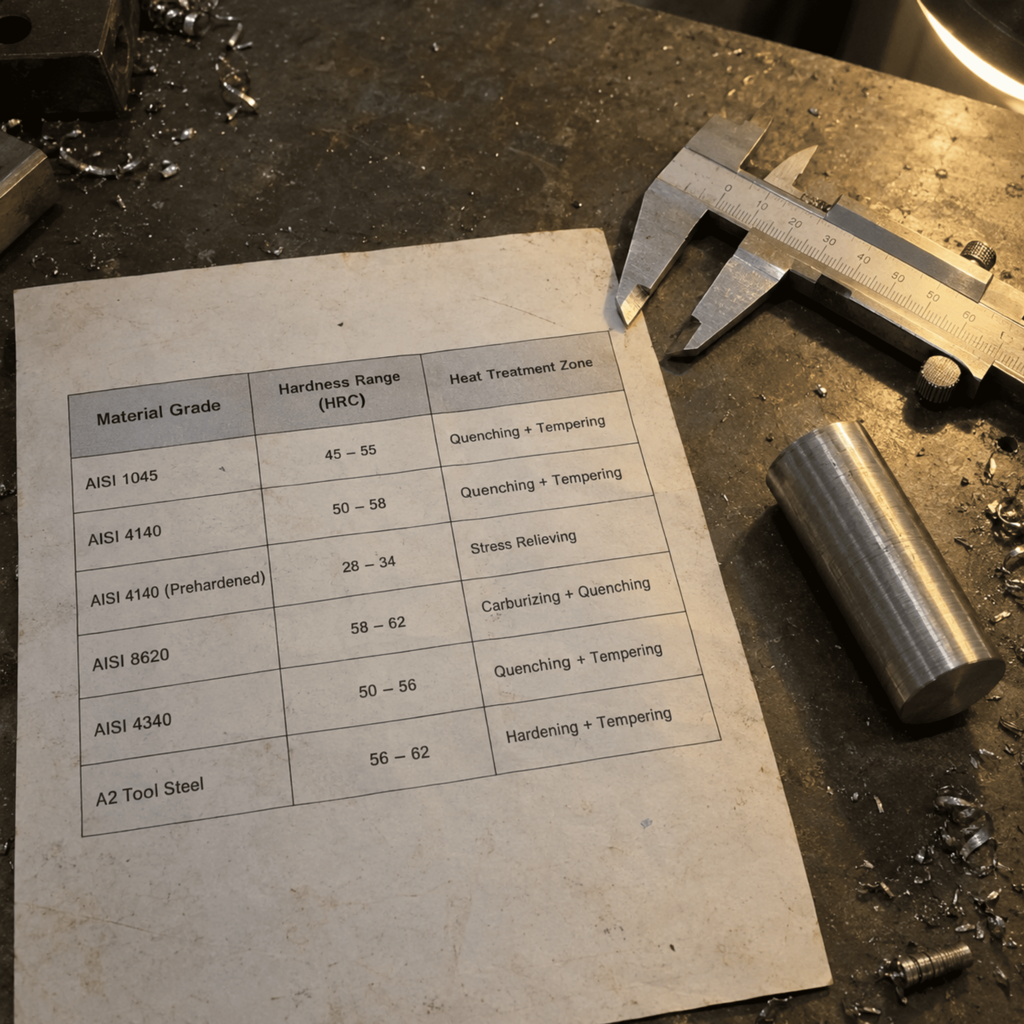
A hand tool safety specification should define the intended use, prohibited uses, material requirements, critical dimensions, heat-treatment conditions, hardness ranges, surface finish, markings, inspection methods, packaging protection, and traceability. Each requirement should reflect the individual tool design rather than applying one steel grade, hardness value, or test method to every product.

Look Beyond Material Labels
A steel family can provide useful information, but a broad label alone does not establish finished-tool quality.6 The final result can also depend on:
- The exact material composition and grade
- Incoming material control
- Forging or forming conditions
- Machining and dimensional accuracy
- Heat-treatment process
- Tempering control
- Surface preparation and coating
- Tool geometry
- Production consistency
For this reason, I avoid treating “Cr-V” as a complete specification. Different grades may fall under broad commercial descriptions, and different tools can require different properties. Impact sockets and manual sockets, for example, should not be assumed to share the same optimal material, hardness, or wall construction.
Procurement teams should ask which requirements are critical to safety and function. They can then agree on how those requirements will be documented and checked.
Specify Heat Treatment by Product Function
Heat treatment requires particular attention because a tool may need different properties in different zones. A cutting edge may require hardness for edge retention, while another section may need greater toughness.7 A striking tool can also require a carefully controlled balance between resistance to deformation and resistance to brittle failure.
I recommend clarifying questions such as:
- Is the whole tool heat-treated or only a functional zone?
- Are separate areas intended to have different hardness ranges?
- Where will hardness measurements be taken?
- Which test method and equipment will be used?
- How will results be linked to the production batch?
- What happens when a reading falls outside the approved range?
No single hardness number should be copied across unrelated hand tools. A qualified engineer or laboratory should confirm whether the proposed material, heat treatment, hardness range, and test method suit the design.
Turn Descriptions Into Verifiable Requirements
| Weak purchasing language | More useful specification approach |
|---|---|
| Industrial-grade steel | Identify the agreed material grade and verification documents |
| Strong heat treatment | Define applicable zones, ranges, methods, and sampling |
| Heavy-duty socket | State drive type, dimensions, intended loading, and test criteria |
| Rust-resistant finish | Define coating system and an agreed evaluation method |
| Safe handle | Define attachment, material, dimensions, grip, and relevant testing |
| Good quality | List measurable critical-to-quality characteristics |
The approved specification should also control changes. A supplier should not substitute material, alter heat treatment, reduce a wall section, or change a subcontractor without the agreed review process. That change-control requirement helps prevent a successful sample from becoming an unreliable production batch.
How Can Buyers Control Hand Tool Safety Across Production Batches?
An approved sample can create false confidence. The sample may satisfy dimensional and appearance checks while later production drifts because of material substitution, worn tooling, heat-treatment variation, or weak subcontractor control.8 I therefore evaluate repeatability rather than treating one sample as proof of ongoing quality.
Buyers can control hand tool safety across batches by creating a quality plan that links materials, production records, in-process checks, final inspection, and traceability. The plan should identify critical characteristics, inspection stages, sampling methods, acceptance rules, responsible parties, and escalation procedures for nonconforming results.
Inspect More Than Appearance
Final visual inspection remains useful. Inspectors can detect corrosion, coating defects, poor markings, burrs, cracks visible under the specified inspection conditions, packaging errors, and obvious dimensional problems. However, appearance alone cannot confirm internal material properties or heat-treatment consistency.9
A more complete control plan may include:
- Incoming material identification and supporting records
- Critical dimensional measurements
- In-process forging or forming checks
- Heat-treatment batch identification
- Hardness checks at defined locations
- Functional checks relevant to the design
- Surface and marking inspection
- Packaging and corrosion-protection review
- Retained records or samples where appropriate
- Traceability from finished goods to production lots
The appropriate tests depend on the product. A pipe wrench, chain wrench, cutter, socket, hex key, pipe stand, and striking tool do not have identical failure modes. Buyers should work with qualified technical specialists to determine which characteristics require destructive testing, nondestructive examination, functional testing, or laboratory verification.
Use a Risk-Based Inspection Plan
Statistical sampling can support batch inspection, but buyers should not select an acceptance quality limit without considering the consequence of failure. Frameworks such as ISO 2859-1 may be relevant to attribute sampling10, subject to the current edition, contract terms, and professional review. However, a sampling framework does not decide whether a particular defect is acceptable.
I usually separate characteristics into practical risk categories:
| Risk category | Examples | Possible control approach |
|---|---|---|
| Safety-critical | Cracks, incorrect material, unsuitable heat treatment | Strong preventive controls and defined rejection rules |
| Functional | Jaw dimensions, socket fit, cutter alignment | In-process and final measurement |
| Durability-related | Coating, tooth geometry, joint condition | Agreed inspection or functional evaluation |
| Cosmetic | Minor finish variation or packaging appearance | Normal visual sampling where appropriate |
The contract should define what happens after a failure. Actions may include containment, expanded inspection, root-cause analysis, corrective action, rework review, or rejection. The responsible technical and quality teams should approve the response.
Assess the Supplier’s Control Capability
During supplier discussions, I look for evidence that the company understands its process rather than simply promising good quality. Useful evaluation points include:
- Control of material suppliers
- Heat-treatment management
- Calibration of inspection equipment
- Handling of nonconforming products
- Batch identification
- Record retention
- Engineering change control
- Corrective-action capability
- Control of subcontracted operations
- Communication speed when a problem appears
Certificates can support a review, but buyers should verify their issuer, scope, validity, applicable site, and relevance. A certificate does not replace product-specific inspection or technical evaluation.11
How Should Maintenance and Retirement Support Hand Tool Safety?
Even a correctly specified tool can become unsafe as its working surfaces wear. If procurement documents cover only new-product acceptance, distributors and end users receive no consistent basis for inspection. I prefer to define cleaning, storage, maintenance, wear indicators, and retirement rules during product development.
Maintenance supports hand tool safety when instructions identify inspection points, permitted servicing, storage conditions, and measurable removal criteria. Users should retire tools with cracks, deformation, damaged engagement surfaces, loose components, severe corrosion, or wear beyond design-specific limits. The manufacturer or qualified specialist should validate every threshold.

Connect Wear to Functional Risk
Wear is not only a cosmetic issue. It can change how a tool transfers load or grips a workpiece.
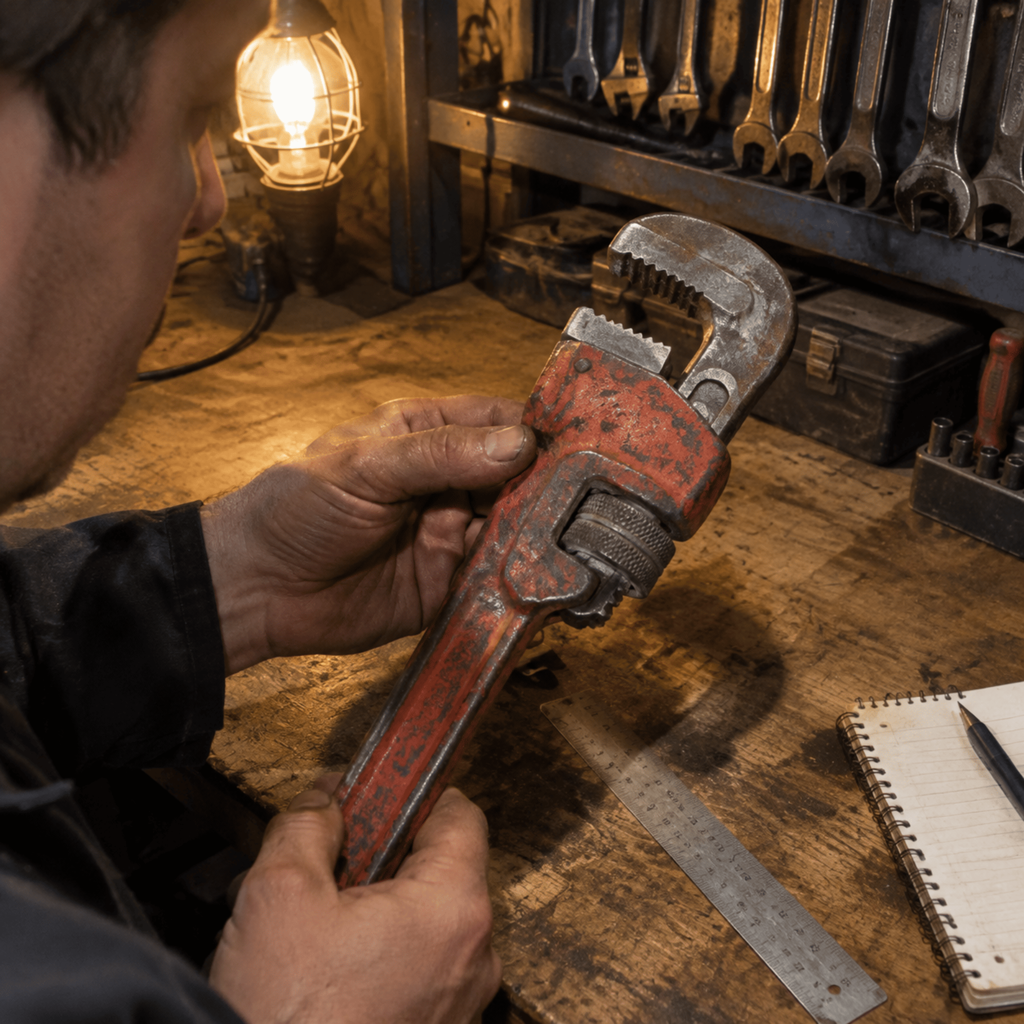
For example, rounded pipe-wrench teeth can reduce engagement and increase the chance of slipping.12 A stretched or worn chain can also fit poorly around the workpiece or interact incorrectly with the tool’s mechanism. Buyers should therefore include tooth condition, chain condition, joint movement, deformation, and corrosion in relevant inspection guidance.
A proposed chain-elongation threshold of approximately 2–3% may appear in some technical discussions, but it should not be presented as a universal retirement rule. The correct limit must be checked against the chain design, manufacturer guidance, intended load, inspection method, and applicable standards.
The same caution applies to other tools. I would not publish one universal retirement limit for:
- Wrench-jaw wear
- Socket-wall deformation
- Cutter-edge damage
- Handle movement
- Hammer-face mushrooming
- Hex-key rounding
- Pipe-stand component wear
Each design needs its own criteria.
Provide a Practical Inspection Routine
A general pre-use review can ask whether the tool has:
- Visible cracks, chips, or deformation
- Rounded or damaged engagement surfaces
- Loose handles, pins, fasteners, or joints
- Severe corrosion or surface damage
- Contamination that affects grip or movement
- Unapproved modifications, welding, grinding, or heating
- Markings that no longer allow identification
- Wear beyond the manufacturer’s stated limit
Users should isolate questionable tools rather than returning them to general storage. A qualified person should decide whether repair is permitted. Some tool designs or damage conditions may require immediate retirement rather than field repair.
Close the Feedback Loop
Distributors and brand owners can collect structured information from returns, inspections, and customer feedback. Useful records include the product code, batch number, application, observed damage, service history, and photographs. This information can reveal patterns that a simple return count misses.
I use that feedback to review several upstream decisions:
- Was the intended application defined correctly?
- Did the instructions communicate prohibited uses?
- Did production remain within specification?
- Did packaging prevent corrosion or transit damage?
- Was the wear criterion practical?
- Does the product design need reassessment?
This closed loop turns maintenance data into better specifications and supplier controls. It also helps procurement teams distinguish between misuse, normal wear, production variation, and a possible design concern. A qualified professional should evaluate any safety-related failure or repeated damage pattern.
Frequently Asked Questions
Is PPE enough to ensure hand tool safety?
No. PPE can reduce exposure to some hazards, but it cannot correct an unsuitable tool, incorrect material, poor heat treatment, or excessive wear. I treat PPE as one layer of control. Correct selection, verified manufacturing quality, user instructions, inspection, and timely retirement remain essential.
Does a chrome finish prove that a hand tool is safe?
No. A chrome finish mainly provides appearance and may contribute to corrosion resistance, depending on the coating system. It does not prove that the underlying material, dimensions, heat treatment, or construction suit the application. Buyers should evaluate those characteristics separately.
Can hand sockets be used with impact wrenches?
Buyers and users should only use sockets that the manufacturer has designed, marked, and approved for impact operation. A manual hand socket should not be assumed suitable because it fits the drive. The material, geometry, wall thickness, heat treatment, and validation requirements may differ.
How should buyers verify hand tool certifications?
Buyers should check the issuing organization, certificate number, validity dates, manufacturing-site scope, product scope, referenced standard, and current edition. They should also confirm whether the document covers a management system or a specific product. Professional review may be necessary for regulated markets.
How often should hand tools be inspected?
The appropriate frequency depends on the tool, workload, environment, failure consequence, and manufacturer guidance. I recommend a pre-use visual check plus documented periodic inspection for tools exposed to heavy, repeated, corrosive, or safety-critical service. Qualified personnel should establish the final schedule.
Conclusion
Effective hand tool safety starts with procurement, not with a warning printed after production. Buyers should define the exact task, replace vague quality labels with measurable specifications, verify batch-level consistency, assess supplier controls, and establish maintenance and retirement criteria. Every technical threshold should reflect the specific design and applicable market requirements.
Ridgimax supports B2B buyers with hand-tool sourcing, OEM/ODM development, specification communication, and quality-control planning. Contact us to discuss your application, purchasing requirements, and supplier evaluation priorities before placing a bulk order.
"Hierarchy of Controls", https://www.cdc.gov/niosh/hierarchy-of-controls/about/index.html. NIOSH's hierarchy of controls prioritizes elimination, substitution, and engineering controls over administrative measures and personal protective equipment, supporting the view that PPE and training cannot correct an inherently unsuitable tool. Evidence role: expert_consensus; source type: government. Supports: Authoritative occupational-safety guidance places hazard elimination, substitution, and engineering controls above training and PPE because controls that depend on worker behavior do not remove the underlying hazard.. Scope note: The hierarchy is general occupational-safety guidance and does not specifically evaluate hand-tool procurement. ↩
"Hand and Power Tools", https://www.osha.gov/sites/default/files/publications/OSHA3080.pdf. Occupational-safety guidance for impact wrenches specifies the use of impact-rated sockets, supporting the conclusion that an ordinary hand socket should not be presumed suitable merely because its drive size fits. Evidence role: general_support; source type: government. Supports: Safety guidance for impact tools instructs users to select sockets specifically rated or designed for impact-wrench operation.. Scope note: Such guidance establishes the usage distinction but may not document every material, geometry, or heat-treatment difference listed in the article. ↩
"(PDF) Wear mechanisms of cutting tools in high-speed ...", https://www.academia.edu/99880636/Wear_mechanisms_of_cutting_tools_in_high_speed_cutting_processes. Research on cutting mechanics shows that required cutting force and edge loading depend on workpiece properties such as hardness and strength, so a diameter rating for soft material does not by itself establish capacity for hardened stock. Evidence role: mechanism; source type: paper. Supports: Materials research should show that workpiece hardness and strength influence cutting force, deformation, and cutting-edge wear or failure.. Scope note: General cutting-mechanics research may not yield a safe capacity for a particular hand-cutter design. ↩
"TOMMARS 9PC T Handle Allen Wrench Set, SAE T ...", https://reframedarchives.sandbox.library.columbia.edu/listing/tommars-9pc-t-handle-allen-wrench-set-sae-t-handle-hex-key-s?srsltid=218100058. Mechanical analysis of ball-end hex engagement indicates that angled contact is concentrated over a smaller area than full-depth straight-end engagement, providing a basis for lower or more restricted torque use. Evidence role: mechanism; source type: paper. Supports: Experimental or mechanical analysis should connect angled ball-end engagement with reduced contact area, increased contact stress, or lower transferable torque.. Scope note: The magnitude of any torque reduction depends on the specific key, fastener geometry, material, engagement depth, and operating angle. ↩
"Nominal Pipe Size", https://en.wikipedia.org/wiki/Nominal_Pipe_Size. Standard pipe-dimension tables distinguish nominal pipe size from actual outside diameter; for many nominal sizes, the designation is not a direct measurement of the pipe exterior. Evidence role: definition; source type: institution. Supports: A recognized dimensional reference should define nominal pipe size and show that its numerical designation does not necessarily equal the pipe's measured outside diameter.. ↩
"Effect of heat treatment on properties and microstructure of ...", https://www.academia.edu/110849420/Effect_of_heat_treatment_on_properties_and_microstructure_of_steels. Metallurgical references establish that the mechanical properties of steel depend on composition, microstructure, forming history, and heat treatment, so a broad alloy-family description alone cannot demonstrate finished-tool performance. Evidence role: mechanism; source type: education. Supports: Metallurgical sources should explain that final steel properties depend on detailed composition, microstructure, manufacturing history, and heat treatment rather than alloy-family terminology alone.. Scope note: This principle supports the need for fuller specifications but does not define acceptance criteria for any particular hand tool. ↩
"SteelSelectionandTreatment < Rise < TWiki", http://bdml.stanford.edu/twiki/bin/view/Rise/SteelSelectionandTreatment.html. Tool-steel research describes a design trade-off in which increased hardness can improve edge retention and wear resistance while adequate toughness remains necessary to resist cracking or brittle fracture, supporting zone-specific property requirements. Evidence role: mechanism; source type: paper. Supports: Materials research should explain the relationship among heat treatment, hardness, wear resistance, and fracture toughness, including why functional zones may be treated differently.. Scope note: The appropriate property balance and heat-treatment profile must still be established for the individual tool geometry and loading conditions. ↩
"Manufacturing", https://www.nist.gov/manufacturing. Statistical quality-control literature treats manufacturing output as subject to common-cause and special-cause variation arising from materials, tooling, equipment, and process changes; consequently, conformity of a single sample does not demonstrate continuing batch conformity. Evidence role: general_support; source type: research. Supports: Quality-engineering literature should establish that production output varies with materials, tooling, equipment, process settings, and supplier controls, requiring ongoing process and batch verification.. Scope note: The literature supports the general need for ongoing control but does not prove that any named cause occurred in a particular hand-tool batch. ↩
"A Review of Non-Destructive Testing (NDT) Techniques for ...", https://pmc.ncbi.nlm.nih.gov/articles/PMC9147555/. Nondestructive-evaluation guidance characterizes visual inspection as primarily a surface examination, while subsurface conditions and material properties require other test methods; visual conformity therefore cannot establish internal metallurgy or heat-treatment consistency. Evidence role: mechanism; source type: government. Supports: Nondestructive-testing guidance should distinguish visual examination of accessible surfaces from methods used to assess subsurface flaws, material identity, hardness, or internal condition.. Scope note: The appropriate supplementary method depends on the material, geometry, defect type, and property being evaluated. ↩
"ISO 2859-1", https://chemistry.unt.edu/~tgolden/courses/iso2859-1.pdf. ISO 2859-1 specifies sampling plans and procedures for inspection by attributes, indexed by acceptance quality limit, and is therefore a recognized framework for lot-based attribute sampling. Evidence role: definition; source type: institution. Supports: The official ISO record should confirm that ISO 2859-1 specifies sampling procedures for inspection by attributes indexed by acceptance quality limit.. Scope note: The standard supplies sampling procedures; it does not determine which defects are tolerable or what risk classification a buyer should assign. ↩
"CCMS - Public Database - Regulations & Compliance", https://www.regulations.doe.gov/certification-data/. ISO guidance distinguishes quality-management-system certification from product certification: certification to ISO 9001 concerns an organization's management system and does not itself certify that an individual product meets a specified technical standard. Evidence role: definition; source type: institution. Supports: Standards or accreditation guidance should distinguish certification of an organization's management system from certification or testing of a particular product.. Scope note: Product-specific certificates may provide different evidence, so the document's scope and certification scheme must be checked. ↩
"Hand and Power Tools", https://www.osha.gov/sites/default/files/publications/OSHA3080.pdf. Occupational hand-tool guidance advises inspection and replacement of pipe-wrench jaws or teeth when they are worn, as degraded gripping surfaces reduce secure engagement and can allow the wrench to slip. Evidence role: mechanism; source type: government. Supports: Hand-tool safety guidance should state that pipe-wrench teeth or jaws must be kept sharp and undamaged because worn gripping surfaces can slip.. Scope note: Such guidance supports inspection and removal of worn components but may not provide a numerical wear threshold for every wrench design. ↩



Leave a Reply