

Knowing how to maintain and store hand tools is essential for reducing corrosion, wear, inaccurate operation, and avoidable complaints. Generic advice can make the problem worse because different mechanisms require different care. I recommend matching every cleaning, inspection, lubrication, calibration, and storage instruction to the tool’s design and documented failure modes.
To maintain and store hand tools correctly, clean them after use, inspect critical parts against manufacturer limits, apply only specified lubricants, protect them from moisture and contamination, and store them without damaging loads. Calibrated tools also need scheduled and incident-triggered reassessment. Any tool that fails its documented inspection criteria should be removed from service pending qualified evaluation.
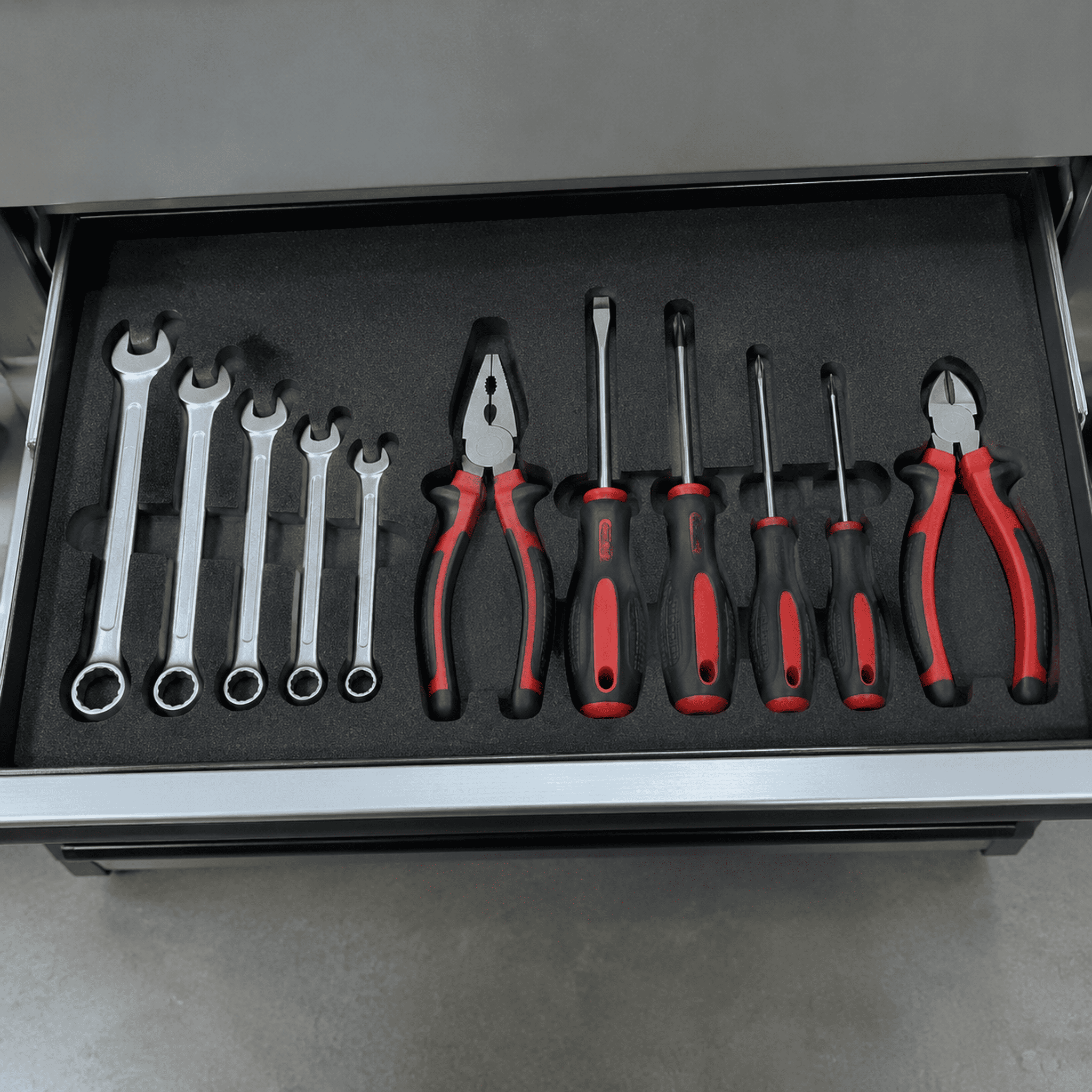
In my product-side experience, the most useful care instructions explain more than how to wipe a tool clean. They connect maintenance to the tool’s mechanism, workload, environment, and likely failure modes. That distinction also helps wholesale buyers evaluate product quality before placing an order.
Why Must Hand Tool Maintenance Follow the Tool’s Mechanism?
A single maintenance routine cannot protect every tool. A rigid pipe wrench, chain wrench, torque wrench, cutting tool, and insulated hand tool each carries loads differently. If I apply a generic routine without understanding the mechanism, I may overlook measurable wear or introduce the wrong lubricant, replacement component, or repair method.
Hand tool maintenance should follow the tool’s load-bearing structure and operating mechanism. Buyers should identify critical parts, approved lubrication points, measurable wear limits, prohibited repairs, and replacement-part requirements from the current manufacturer documentation. Appearance alone cannot confirm that a tool remains suitable for service.
A Chain Wrench Shows Why Appearance Is Not Enough
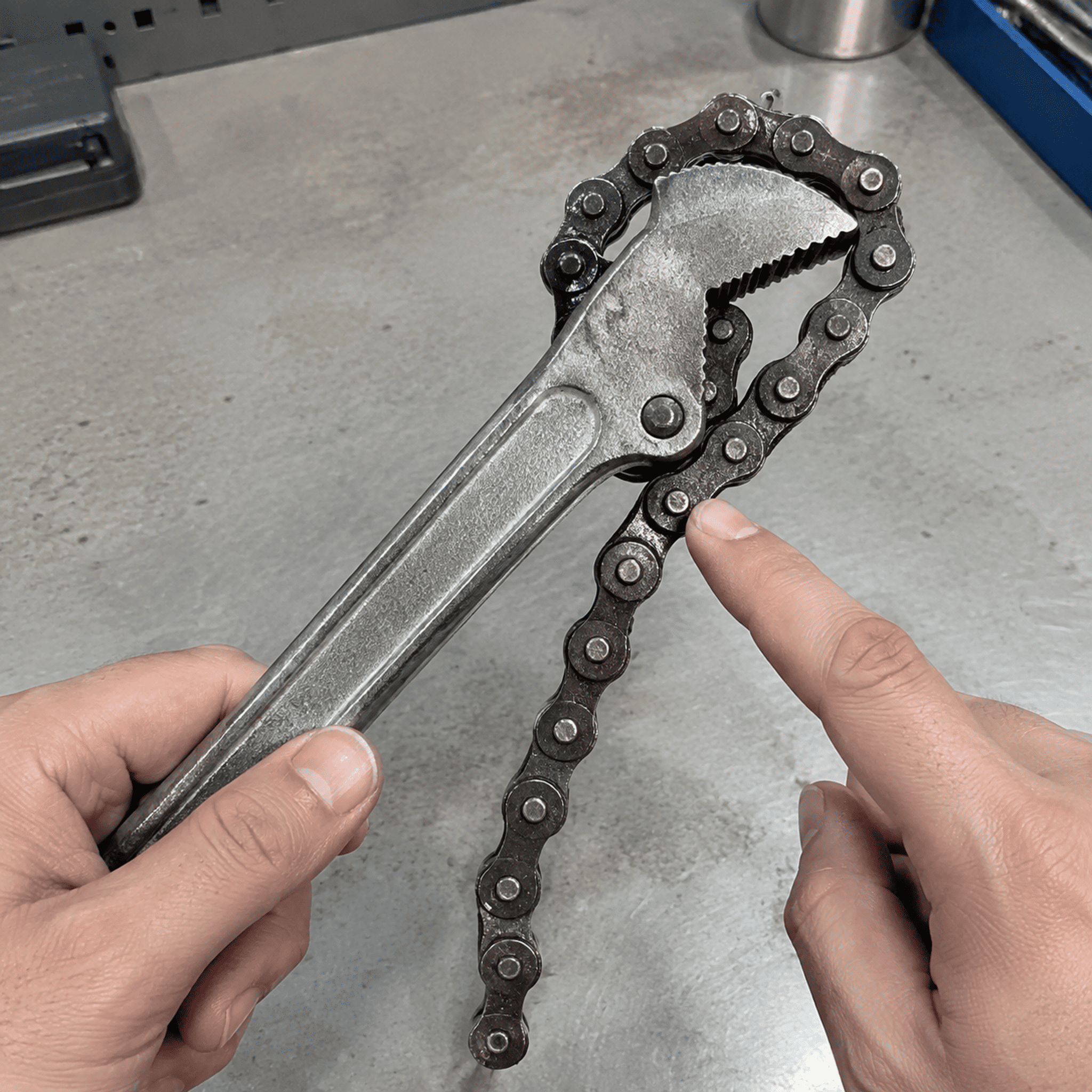
The PETOL chain pipe wrench provides a useful mechanism-specific example. Its chain, pins, sidebars, jaws, and related load-bearing components operate together. A tool may look acceptable from a distance while chain elongation or dimensional wear has moved beyond the limits stated in the applicable operating instructions.1
PETOL guidance should be checked in its current manual for the exact model and revision. I would not copy numerical limits from an older document into a new product manual without confirmation. However, the broader procurement lesson remains valid: inspection should include the dimensions and conditions that the manufacturer identifies as safety-critical.
For a chain wrench, a buyer should look for instructions covering:
- How chain elongation is measured
- Which component dimensions require inspection
- Where lubricant should be applied
- What purpose the lubricant serves
- Which replacement links or assemblies are compatible
- Whether field repair, heating, welding, or plating is prohibited
- What conditions require removal from use and qualified assessment
Lubrication also needs a stated purpose. In PETOL documentation, lubrication around chain pins and holes is associated with preserving an oil film at the articulating surfaces2. That is more precise than telling users to “oil the tool regularly.” The correct product, amount, and interval still depend on the current instructions for that model.
Repairs Can Alter Load-Bearing Components
A repair that restores appearance may not restore strength. Heating or welding a loaded chain component can alter material properties.3 Plating an assembled chain can introduce process-related concerns4 and may prevent proper treatment or inspection of individual surfaces. Mixing links or components that were not specified as compatible can also change load distribution.
I do not treat these points as universal rules for every chain tool. I attribute them to the relevant manufacturer instructions and verify the instructions during sourcing. Different designs, materials, and assembly processes can require different controls.
A useful supplier manual should distinguish among routine user care, replaceable components, authorized repair, and retirement criteria.
| Maintenance question | Weak instruction | More useful instruction |
|---|---|---|
| What should be inspected? | “Check before use” | Identifies pins, chain, jaws, fasteners, and critical dimensions |
| How is wear assessed? | “Replace when worn” | Provides a measurement method and model-specific limit |
| Where is lubrication needed? | “Oil regularly” | Identifies the point, purpose, lubricant specification, and interval |
| Can parts be repaired? | No guidance | Lists prohibited modifications and approved repair routes |
| Which parts fit? | “Use suitable parts” | Provides verified part numbers or compatibility information |
| When should use stop? | “Use with care” | Defines conditions requiring isolation and qualified evaluation |
When I evaluate a hand-tool range, I view this level of detail as part of product development. It reduces ambiguity for distributors, service teams, and end users.
How Should I Maintain and Store Hand Tools on a Defined Schedule?
Calendar-based maintenance is easy to administer, but it can miss damage caused by a drop, overload, contamination, or harsh environment. Event-only inspection has the opposite weakness because gradual wear can remain unnoticed. I therefore prefer a system that combines planned intervals with clear triggering events.
To maintain and store hand tools under a controlled program, set inspection intervals according to workload, risk, manufacturer guidance, and operating conditions. Add immediate checks after abnormal events such as drops, overloads, unexpected readings, corrosion exposure, prolonged storage, or poor maintenance. Calibrated tools may require reassessment by a competent laboratory or service provider.
Planned Intervals Create a Baseline
A planned program gives procurement and quality teams a repeatable baseline. The interval should reflect how the tool is used rather than relying on an arbitrary date alone.5
I would consider:
- Frequency of use: A tool used across several production shifts experiences a different workload from an emergency tool kept in a cabinet.
- Load severity: Repeated use near a tool’s rated capacity may justify closer monitoring.
- Operating environment: Humidity, salt, dust, abrasive particles, and chemicals can increase deterioration.6
- Tool consequence: An inaccurate torque tool can affect assembly quality even when it still looks new.7
- Manufacturer instructions: The current manual should remain the primary product-specific reference.
- Previous inspection data: Recurring drift or wear can justify changing an interval.
Triggering Events Override the Calendar
A scheduled inspection next month does not justify continued use after a tool has suffered a significant incident. The care plan should define which events trigger isolation, inspection, functional verification, or recalibration.
Typical triggers may include:
- A significant drop or impact
- Suspected overload or misuse
- Abnormal sound, movement, or resistance
- Unexpected torque or measurement readings
- Exposure to water, salt, chemicals, or extreme temperatures
- Visible cracking, deformation, pitting, or loose components
- Missing maintenance history
- Prolonged or uncontrolled storage
- Improper previous maintenance
The response should depend on the tool and the applicable instructions. A light surface mark on a noncritical handle is not equivalent to deformation in a load-bearing component. I recommend that businesses avoid giving untrained users unrestricted authority to make safety-critical judgments.
Torque Tools Need Calibration Control
Torque tools illustrate why maintenance and storage must extend beyond cleaning. The ISO 6789 series addresses requirements and calibration for hand torque tools.8 Published industry guidance commonly associates recalibration with a period such as 12 months or approximately 5,000 operations9, whichever occurs first, but that wording should not be treated as a universal rule for every tool and situation.
Before specifying an interval, buyers should verify:
- The applicable part and current edition of ISO 6789
- The torque-tool category
- The manufacturer’s instructions
- Frequency and severity of use
- Customer or regulatory requirements
- Previous calibration results
- Environmental and storage conditions
A drop, an abnormal reading, prolonged storage, poor maintenance, or extreme exposure may justify reassessment before the normal interval.10 A qualified calibration provider should make application-specific decisions and issue traceable records where required.
I see calibration as a controlled measurement activity, not a cleaning task. A neat tool drawer cannot prove that a torque wrench remains accurate.
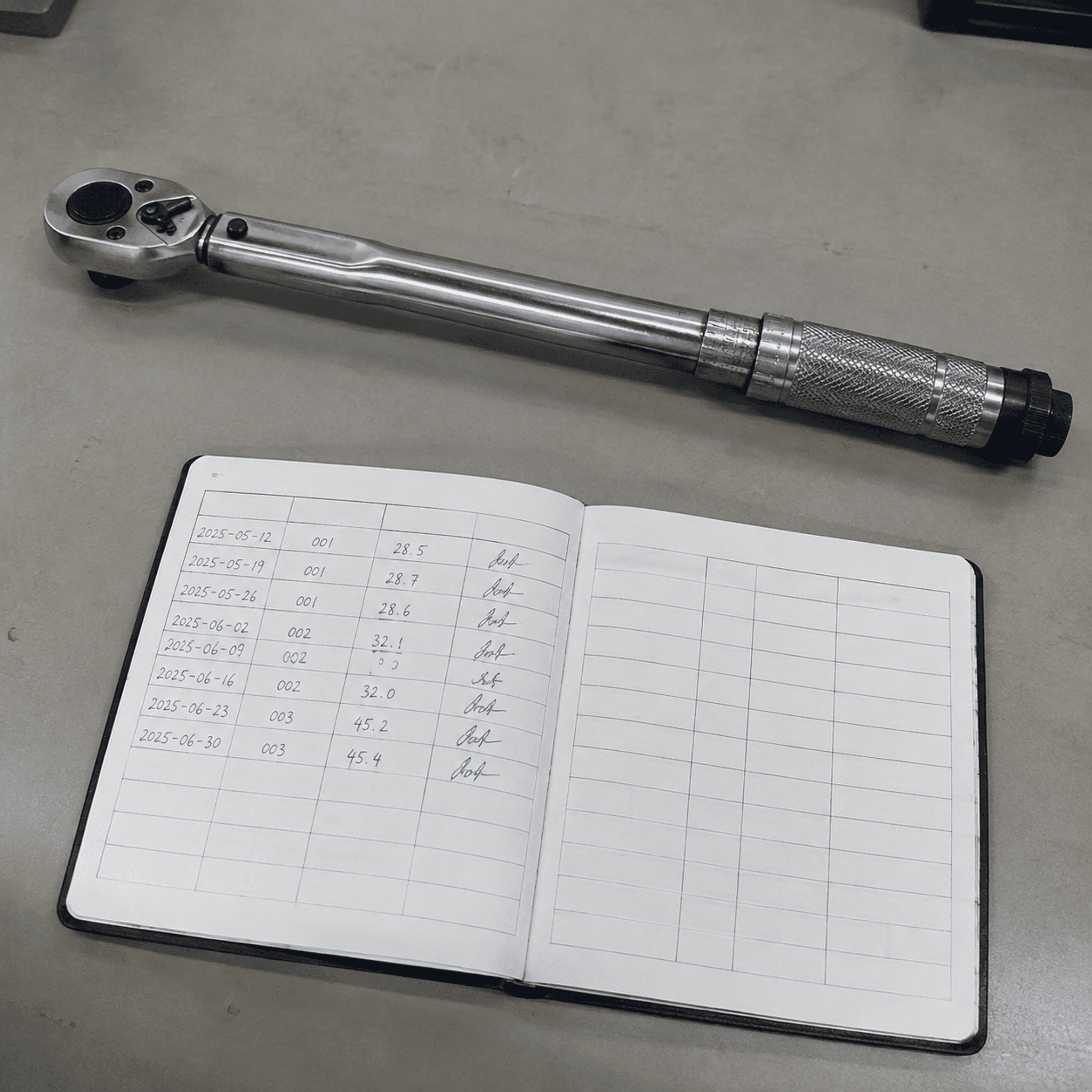
A practical record can be simple but should remain traceable.
| Record field | Why it matters |
|---|---|
| Tool model and serial number | Identifies the exact tool |
| Date placed in service | Establishes the service timeline |
| Estimated operation count | Connects checks to actual use |
| Inspection and calibration dates | Shows completed control activities |
| Incident history | Captures drops, overloads, and exposure |
| Result and action | Records release, adjustment, repair, or isolation |
| Responsible person or provider | Establishes accountability |
How Can Proper Hand Tool Storage Reduce Corrosion and Damage?
Poor storage can undo careful maintenance. Moisture, condensation, abrasive dust, chemical vapors, and contact between tools can damage surfaces and moving parts. However, I do not assume that a shiny coating provides complete protection. Storage controls must account for the base material, coating integrity, packaging, and local environment.
Proper hand tool storage reduces avoidable damage by keeping tools clean, dry, separated, supported, and protected from corrosive or extreme environments. Storage should prevent condensation, contamination, impact, and damaging loads. Coated tools still require inspection because pores, cracks, or local coating defects may allow corrosion to develop beneath an acceptable-looking surface.
Visible Finish Does Not Prove Corrosion Resistance
A published failure analysis involving a chrome-plated 40Cr piston rod illustrates an important mechanism. Researchers associated with Hebei University of Science and Technology reported that through-cracks and pores in the plated layer could provide paths for corrosion beneath the coating11. Reported coating thickness or hardness figures alone did not eliminate the failure mechanism.
I use this study only as an illustration of how coating defects can permit underfilm corrosion. A piston rod is not automatically equivalent to a hand tool, and the study does not establish a universal hand-tool cleaning fluid, lubricant, or storage treatment. Buyers should consult the original publication and qualified materials specialists before applying its findings to a specific product.
The procurement lesson is narrower and more useful:
- Nominal coating type does not describe every aspect of coating quality.
- Average thickness may not reveal localized pores or cracks.
- Surface hardness does not guarantee freedom from defects.
- A bright finish does not prove that corrosion has not started underneath.
- Routine care reduces exposure but cannot eliminate hidden manufacturing defects.
Storage Should Control the Environment and the Load
When I plan how to maintain and store hand tools, I separate environmental controls from physical organization.
Environmental controls may include:
- A dry and ventilated storage location
- Protection from rain, salt spray, chemical fumes, and washdown
- Measures that limit condensation after temperature changes
- Clean packaging that does not trap moisture
- Humidity monitoring where the product and risk justify it
- Isolation from corrosive substances
Physical organization may include:
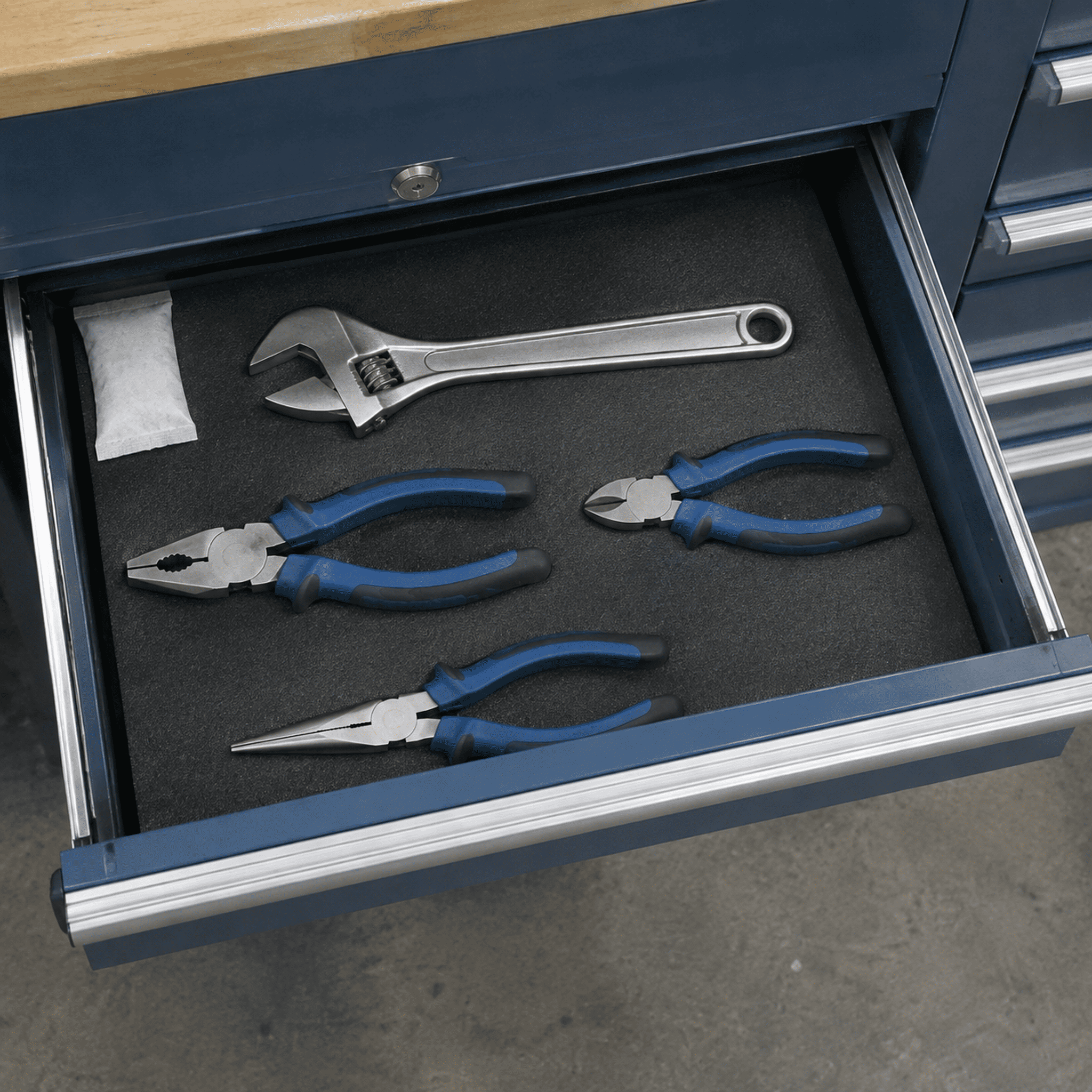
- Drawers, racks, cases, or shadow boards sized for the tool
- Dividers that reduce tool-to-tool impact
- Supports that prevent bending or deformation
- Blade, jaw, or edge protection where specified
- Secure storage for calibrated and controlled tools
- Separate areas for clean, dirty, quarantined, and rejected tools
I once reviewed a storage layout where every tool had a marked position, but returned tools entered the same cabinet before cleaning and inspection. The layout looked organized, yet contamination moved directly into the clean storage area. That experience reinforced my view that storage is a process, not just a box or cabinet.
Long-Term Storage Needs a Return-to-Service Step
Tools can deteriorate while unused. Long-term storage procedures should therefore address preparation, periodic checks, and return to service.
A documented process can include:
- Clean the tool according to its instructions.
- Allow it to dry fully where water-based cleaning is permitted.
- Apply only the specified protective product or lubricant.
- Release adjustable mechanisms if the manufacturer requires it.
- Protect critical surfaces from impact and contamination.
- Record the storage date and condition.
- Inspect or verify the tool before it returns to use.
- Reassess calibration when required by the tool instructions or quality system.
The exact steps will vary. For example, some torque wrench designs have specific requirements for storage settings, while other designs do not use the same mechanism. Buyers should not turn one model’s instruction into a rule for an entire category.
How Should Buyers Evaluate Hand Tool Maintenance and Storage Instructions?
Product specifications usually focus on dimensions, materials, finish, capacity, and packaging. Those details matter, but they do not explain how a buyer should manage the product after delivery. Incomplete lifecycle guidance can create user mistakes, inconsistent service decisions, warranty disputes, and unnecessary brand risk.
Buyers should evaluate hand tool maintenance and storage instructions as part of supplier qualification. A useful manual defines cleaning methods, lubrication points, inspection criteria, measurable wear limits, storage conditions, calibration needs, incident-triggered checks, approved replacement components, and retirement or escalation procedures. The instructions should match the exact model rather than rely on generic wording.
Ask for Evidence Before Approving the Range
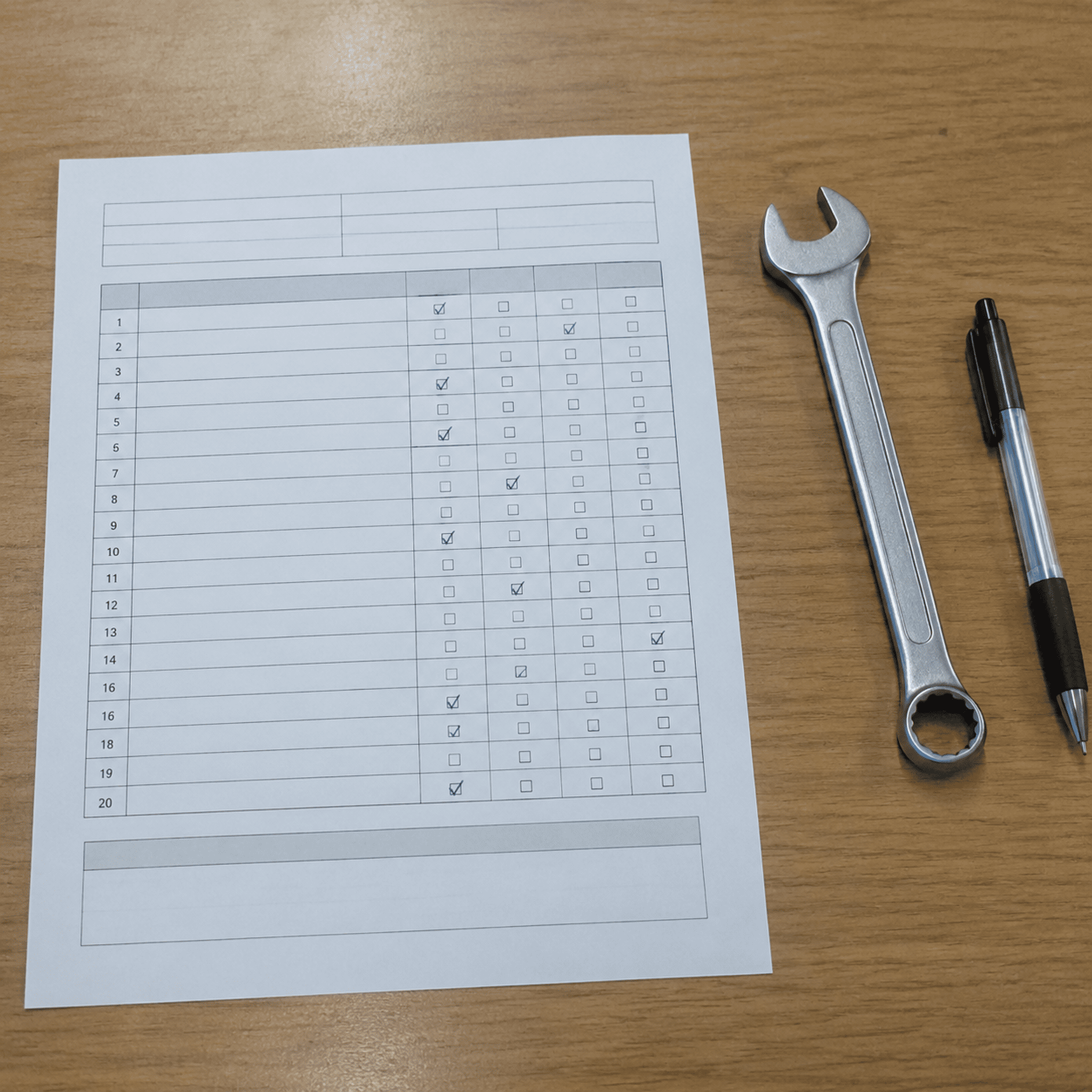
I recommend reviewing lifecycle documentation during product evaluation, not after the first complaint. A buyer can request a sample manual, inspection sheet, exploded drawing, spare-parts list, packaging specification, and available test or calibration documentation.
Useful questions include:
- Does the manual identify critical load-bearing parts?
- Does it give measurable inspection criteria where appropriate?
- Are lubrication points and lubricant specifications clear?
- Does it explain what users must not modify?
- Does it list compatible replacement parts?
- Does it distinguish routine maintenance from qualified repair?
- Does it define storage temperature or humidity limits when necessary?
- Does it address drops, overloads, abnormal readings, and exposure?
- Does it explain calibration or verification requirements?
- Does it provide traceable model and document revision information?
I also check whether translated manuals preserve technical meaning. A fluent translation can still be unsafe if it changes units, removes conditions, or turns a qualified recommendation into an absolute instruction.
Compare Suppliers on Lifecycle Support
A supplier’s response to these questions often reveals its product-management capability.
| Evaluation area | Lower-confidence response | Stronger procurement evidence |
|---|---|---|
| Cleaning | “Wipe after use” | Model-specific method and restrictions |
| Lubrication | “Use oil” | Defined location, purpose, product type, and interval |
| Inspection | Visual check only | Visual and measurable criteria linked to parts |
| Calibration | Not mentioned | Applicable standard, interval logic, and event triggers |
| Storage | “Keep dry” | Environmental, physical, and long-term storage guidance |
| Spare parts | Generic availability claim | Controlled part numbers and compatibility |
| Repair | Unclear | Authorized scope and prohibited alterations |
| Documentation | Undated file | Model number, revision, date, and language control |
| Certifications | Marketing statement | Verifiable documents with scope and issuing body |
Certifications and test reports should always be treated as documents to verify. A logo on a brochure does not prove that a certificate applies to the exact factory, model, process, or current production lot.
Make Lifecycle Instructions Part of Product Development
For OEM and ODM projects, I prefer to define maintenance information alongside product specifications. This approach gives the supplier time to align the manual, labels, packaging, replacement parts, and quality-control documents.
The final product file may include:
- Product specification and approved drawing
- Incoming and production inspection criteria
- Finished-product inspection plan
- User and maintenance manual
- Calibration guidance where applicable
- Spare-parts matrix
- Packaging and storage specification
- Label and warning review
- Document revision history
- Process for handling nonconforming or returned tools
This documentation does not guarantee that a tool will never fail. It does, however, give distributors and users a more consistent basis for inspection, care, escalation, and retirement decisions.
Frequently Asked Questions
How often should hand tools be cleaned?
I recommend cleaning hand tools after use when they have been exposed to dirt, moisture, chemicals, or abrasive material. The exact method and interval should follow the manufacturer’s instructions. High-use tools may also need planned cleaning during a shift, while stored tools may require periodic condition checks.
Can I use the same lubricant on every hand tool?
No. Different mechanisms, materials, seals, coatings, and working environments may require different lubricants. An unsuitable product can attract contaminants, attack materials, or interfere with operation.12 I advise buyers to request the specified lubricant type, application point, quantity, and interval for each relevant tool model.
Should a dropped torque wrench be recalibrated?
A significant drop should trigger isolation and assessment under the manufacturer’s instructions and the organization’s calibration procedure. The tool may require functional checks or recalibration before further use. I would not wait automatically for the next scheduled date when an incident could have affected measurement performance.
Is a chrome-plated tool protected from all corrosion?
No. Chrome plating can improve surface properties, but pores, cracks, damage, or incomplete coverage can allow corrosion to begin at or beneath the coating. Proper storage and inspection remain necessary. Buyers should also evaluate coating-process controls rather than relying only on appearance or a nominal thickness value.
What should I check before returning a stored tool to service?
I would check cleanliness, corrosion, cracks, deformation, loose parts, moving action, identification, and maintenance history. Controlled or calibrated tools may need verification or recalibration. The final decision should follow the manufacturer’s instructions, internal quality procedures, and qualified professional evaluation where safety or measurement accuracy is involved.
Conclusion
The best way to maintain and store hand tools is to match care instructions to each tool’s mechanism, workload, failure modes, and environment. Buyers should look beyond generic advice and request measurable inspection limits, specified lubrication, controlled storage conditions, calibration guidance, incident-triggered checks, and compatible replacement information. Good documentation cannot eliminate every hidden defect, but it can reduce ambiguity and procurement risk.
At Ridgimax, I support wholesale, OEM, and ODM buyers with hand-tool sourcing, product development, storage solutions, and lifecycle-documentation review. Contact our team to discuss your tool range, specifications, packaging, and quality-control requirements.
"PETOLTM Chain Tong Operating Manual", https://petol.com/files/documents/CPAXX.pdf. The applicable PETOL operating instructions prescribe dimensional inspection of specified chain-wrench components and define model-specific limits that cannot be established by visual appearance alone. Evidence role: case_reference; source type: other. Supports: The current PETOL instructions should identify the load-bearing components, measurement procedures, dimensional limits, and conditions requiring removal from service.. Scope note: The cited limits apply only to the models and document revisions covered by the operating instructions. ↩
"PETOLTM Chain Tong Operating Manual", https://petol.com/files/documents/CPAXX.pdf. PETOL's model-specific operating instructions describe lubrication at the chain pins and holes as a means of maintaining an oil film at the articulating surfaces. Evidence role: case_reference; source type: other. Supports: PETOL documentation should state where lubricant is applied and explain that lubrication maintains an oil film around the chain's articulating pin-and-hole surfaces.. Scope note: This documentation does not establish the correct lubricant, quantity, or interval for chain tools from other manufacturers. ↩
"Simulation and Mechanical Properties of Fine-Grained Heat ...", https://pmc.ncbi.nlm.nih.gov/articles/PMC9573272/. Metallurgical studies show that welding creates a heat-affected zone in which thermal cycling can alter microstructure, hardness, residual stress, and mechanical performance. Evidence role: mechanism; source type: paper. Supports: Metallurgical research should document how welding heat cycles can alter microstructure, hardness, residual stress, toughness, or fatigue behavior in load-bearing steels.. Scope note: The magnitude and safety significance of these changes depend on the alloy, prior heat treatment, welding procedure, geometry, and subsequent processing. ↩
"review of literature on hydrogen embrittlement", https://ntrs.nasa.gov/api/citations/19660014216/downloads/19660014216.pdf. Research on plated high-strength steels identifies hydrogen uptake during surface preparation and electroplating as a potential cause of embrittlement and delayed fracture. Evidence role: mechanism; source type: research. Supports: Authoritative materials research should explain that electrocleaning, pickling, and electroplating can introduce hydrogen into susceptible high-strength steels and thereby reduce ductility or delayed-fracture resistance.. Scope note: This mechanism does not prove that every plated chain is unsafe and does not directly establish the article's separate concern about access to individual surfaces in an assembled chain. ↩
"Recommended Calibration Interval", https://www.nist.gov/calibrations/recommended-calibration-interval. OIML D 10 and ILAC-G24 treat calibration intervals as equipment-specific controls informed by stability, use, environment, required accuracy, and prior calibration results rather than by elapsed time alone. Evidence role: expert_consensus; source type: institution. Supports: International metrology guidance should describe calibration intervals as dependent on factors including required uncertainty, equipment stability, frequency and severity of use, environment, and prior calibration results.. Scope note: These documents address measuring equipment generally and do not prescribe inspection intervals for every type of nonmeasuring hand tool. ↩
"PDR: CORR-DATA", https://data.nist.gov/pdr/lps/54AE54FB37AC022DE0531A570681D4291851. Corrosion-control literature identifies moisture, high relative humidity, chlorides, and chemical contaminants as major contributors to metallic corrosion, while hard particulate contamination can increase abrasive wear at moving interfaces. Evidence role: mechanism; source type: government. Supports: Government corrosion guidance should explain the roles of moisture, humidity, chlorides, and chemical contaminants, while tribology evidence should address particle-driven abrasive wear.. Scope note: The rate of deterioration depends on material, coating, contaminant concentration, temperature, exposure duration, and tool design. ↩
"Operational Evaluation of Bolt Preload Achieved by Torque ...", https://digital.library.unt.edu/ark:/67531/metadc931515/m2/1/high_res_d/972786.pdf. Bolted-joint studies establish that tightening torque is an indirect means of generating preload, so torque error can contribute to insufficient or excessive clamp load even when the tool has no visible defect. Evidence role: mechanism; source type: paper. Supports: Bolted-joint research should show that applied torque is used to generate preload and that torque error or scatter can produce under-tightening or over-tightening.. Scope note: Joint friction, fastener geometry, lubrication, and tightening procedure also contribute substantially to preload variation. ↩
"ISO 6789-2:2017 - Hand torque tools", https://www.iso.org/standard/62550.html. ISO 6789-1 specifies requirements and conformity-testing methods for hand torque tools, while ISO 6789-2 specifies calibration procedures and the evaluation of measurement uncertainty. Evidence role: definition; source type: institution. Supports: ISO 6789-1 should establish design and conformity-testing requirements, while ISO 6789-2 should establish calibration and measurement-uncertainty requirements for hand torque tools.. ↩
"Torque Wrench Calibration: Intervals and Tolerances", https://www.fabrico.io/blog/torque-wrench-calibration/. ISO 6789 identifies 12 months or 5,000 cycles, whichever occurs first, as an initial recalibration interval in the absence of an established control procedure, after which the interval may be adjusted using service and calibration data. Evidence role: statistic; source type: institution. Supports: The relevant ISO 6789 provision should support 12 months or 5,000 cycles as an initial/default interval when no established control procedure supplies a different interval.. Scope note: This is not an unconditional interval for every torque tool; the applicable edition, tool class, manufacturer instructions, use, incidents, and quality-system requirements remain relevant. ↩
"Calibration Policies", https://www.nist.gov/calibrations/policies. Calibration guidance treats overload, repair, improper handling, suspected malfunction, and other events capable of affecting measurement validity as grounds for verification or recalibration outside the normal schedule. Evidence role: general_support; source type: institution. Supports: Standards or metrology guidance should state that overload, repair, improper handling, suspected malfunction, or conditions affecting measurement validity can trigger calibration or verification before the routine due date.. Scope note: The cited guidance may not enumerate every example in the article, and reassessment does not necessarily mean that a full recalibration is required after every minor incident. ↩
"Failure Analysis of Chromium Plating Layer on the Surface ...", https://finishingandcoating.com/index.php/plating/2254-failure-analysis-of-chromium-plating-layer-on-the-surface-of-the-piston-rod-of-the-hydraulic-jack. A failure analysis of a hard-chromium-plated 40Cr piston rod reported through-cracks and pores in the coating that provided pathways for corrosive media to reach and attack the underlying steel. Evidence role: case_reference; source type: paper. Supports: The original failure-analysis paper should report cracks or pores in the chromium layer and associate those defects with penetration of corrosive media and substrate corrosion.. Scope note: The study concerns a piston rod in a particular service environment and illustrates a plausible coating-failure mechanism rather than proving the corrosion behavior of all chrome-plated hand tools. ↩
"Research on the Material Compatibility of Elastomer Sealing ...", https://pmc.ncbi.nlm.nih.gov/articles/PMC9414156/. Lubricant-compatibility and tribology studies show that lubricant chemistry can degrade or swell susceptible polymers and that particle-laden lubricant can alter friction and increase abrasive wear. Evidence role: mechanism; source type: paper. Supports: Tribology and compatibility studies should document that lubricant chemistry can cause swelling, softening, extraction, or degradation in susceptible polymers and that retained particles can contribute to abrasive wear or altered friction.. Scope note: Compatibility is specific to the lubricant formulation, material, contaminant, temperature, and operating conditions; the evidence does not identify a universally unsuitable product for all hand tools. ↩



Leave a Reply