
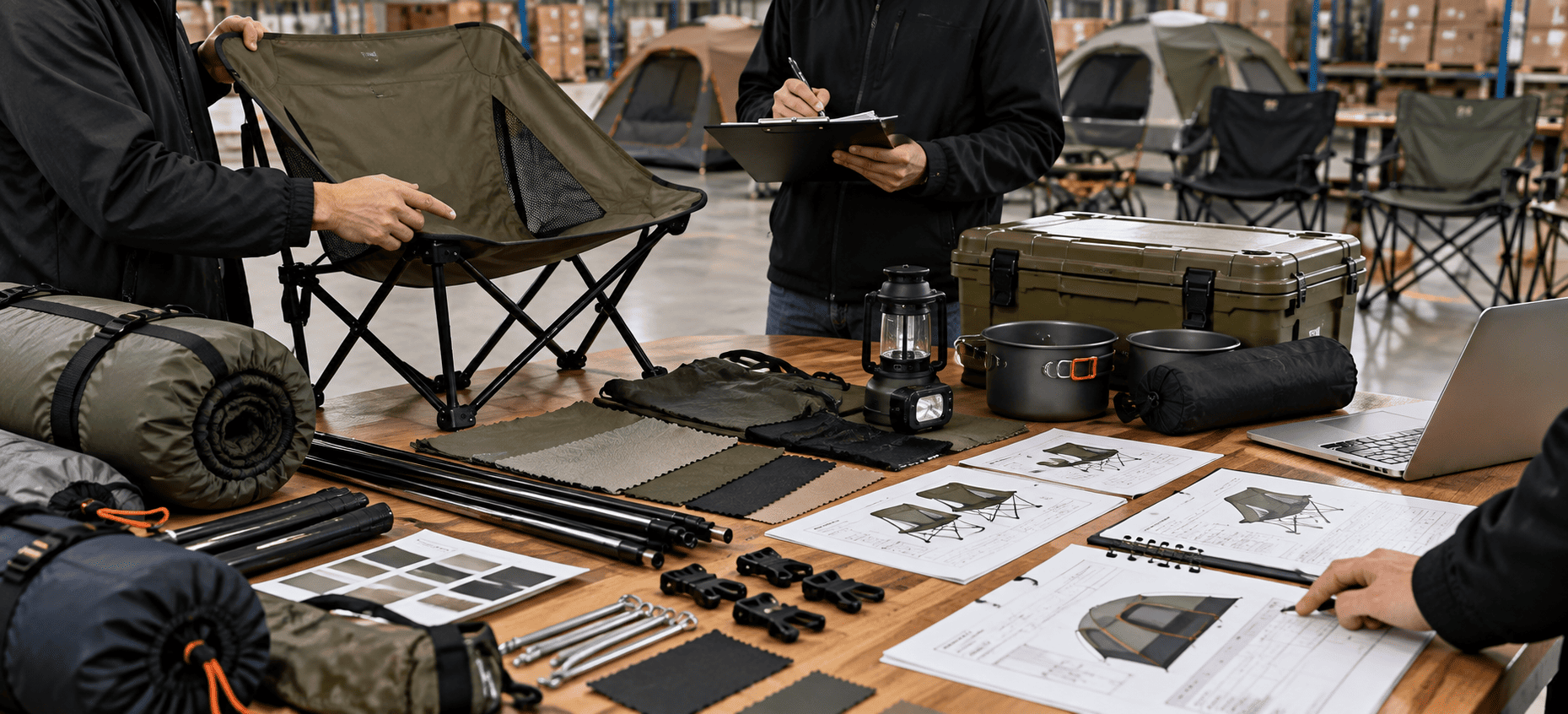
Camping equipment suppliers can look equally capable when a sourcing process begins with prices and polished samples. However, seasonal orders expose differences in materials, production control, inspection, and communication. I recommend evaluating whether each supplier can preserve the approved product standard from the first quotation through mass production and shipment.
Wholesalers should choose camping equipment suppliers by comparing contract-specific quality controls, not unit price or sample appearance alone. A qualified supplier should follow an approved BOM, control incoming materials, reproduce a sealed sample, support SKU-specific inspections, provide traceable documents, and leave enough time to correct defects before the seasonal shipping deadline.
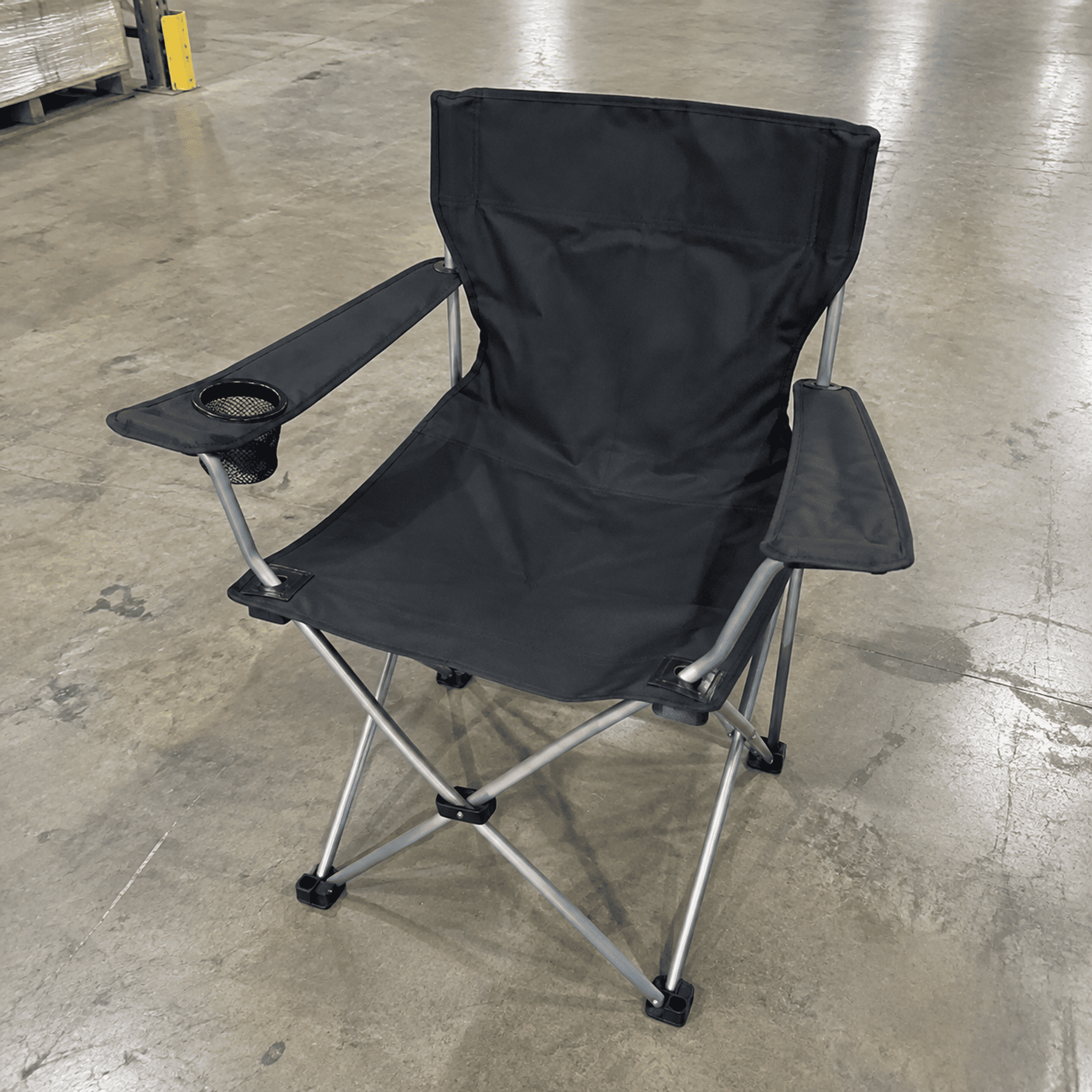
In my supplier-side communication work, I often see inquiries begin with price, quantity, and destination. Those points matter, but they do not define what the buyer expects to receive. I use the following framework to align product requirements, production evidence, inspections, and seasonal risk before an order advances.
What Should Wholesalers Define Before Comparing Camping Equipment Suppliers?
A vague RFQ creates a hidden procurement problem.1 Different camping equipment suppliers may quote different fabrics, frames, accessories, packaging, or inspection levels while using the same product description. The lowest quotation may simply represent a lower specification, which makes price comparisons unreliable and increases the chance of disputes later.
I recommend defining the approved sample, SKU-specific bill of materials, dimensions, tolerances, applicable market requirements, packaging, inspection scope, and document expectations before comparing quotations. Every supplier should quote against the same specification. This process helps a wholesaler distinguish a genuine cost advantage from an unannounced reduction in materials, workmanship, or quality control.

Build the RFQ around a product definition
In my experience handling wholesale inquiries, I often need to ask several questions before a meaningful quotation is possible. A request for “a folding camping chair” does not tell me the required frame material, fabric construction, dimensions, surface finish, load requirement, packaging, or destination-market obligations.
A useful RFQ package should identify:
- The contracted SKU and revision number
- An approved reference sample, when available
- A SKU-specific BOM
- Materials and material grades
- Key dimensions and acceptable tolerances
- Color standards or approved color references
- Logo position, dimensions, and printing method
- Accessories and replacement parts
- Retail and export packaging requirements
- Labeling, warnings, manuals, and carton marks
- Required functional or performance checks
- Applicable regulatory or customer-specific requirements
- Inspection timing and acceptance method
- Required laboratory reports or supplier documents
The buyer should also identify which requirements are critical and which allow commercial flexibility. For example, a small variation in an outer carton dimension may be negotiable. A change in frame construction, fabric coating, buckle material, or insulation filling may not be.
Make every quotation comparable
I suggest using a quotation comparison table rather than comparing unit prices in isolation.
| RFQ item | Supplier A | Supplier B | Buyer verification |
|---|---|---|---|
| Fabric specification | Stated construction | Alternative offered | Compare with approved BOM |
| Frame or structural material | Listed by grade or type | General description only | Request material details |
| Product dimensions | Tolerances included | Nominal values only | Clarify measurement method |
| Packaging | Retail box and export carton | Export carton only | Compare full packaging cost |
| Inspection | Internal inspection included | Not described | Define third-party access |
| Testing documents | SKU-specific reports proposed | Generic report supplied | Check model and material match |
| Lead time | Production stages explained | Single completion date | Assess seasonal buffer |
This table makes exclusions visible. It also prevents a common mistake: negotiating the cheapest offer first and defining the required quality afterward.
I treat an approved sample as one part of the contract, not as a substitute for written specifications.
The RFQ should state how conflicts will be handled. If the sample, drawing, BOM, and purchase order disagree, the parties need a clear document hierarchy. A signed specification sheet and controlled revision process can reduce confusion when designs change during development.2
How Do Camping Equipment Suppliers Transfer Samples into Mass Production?
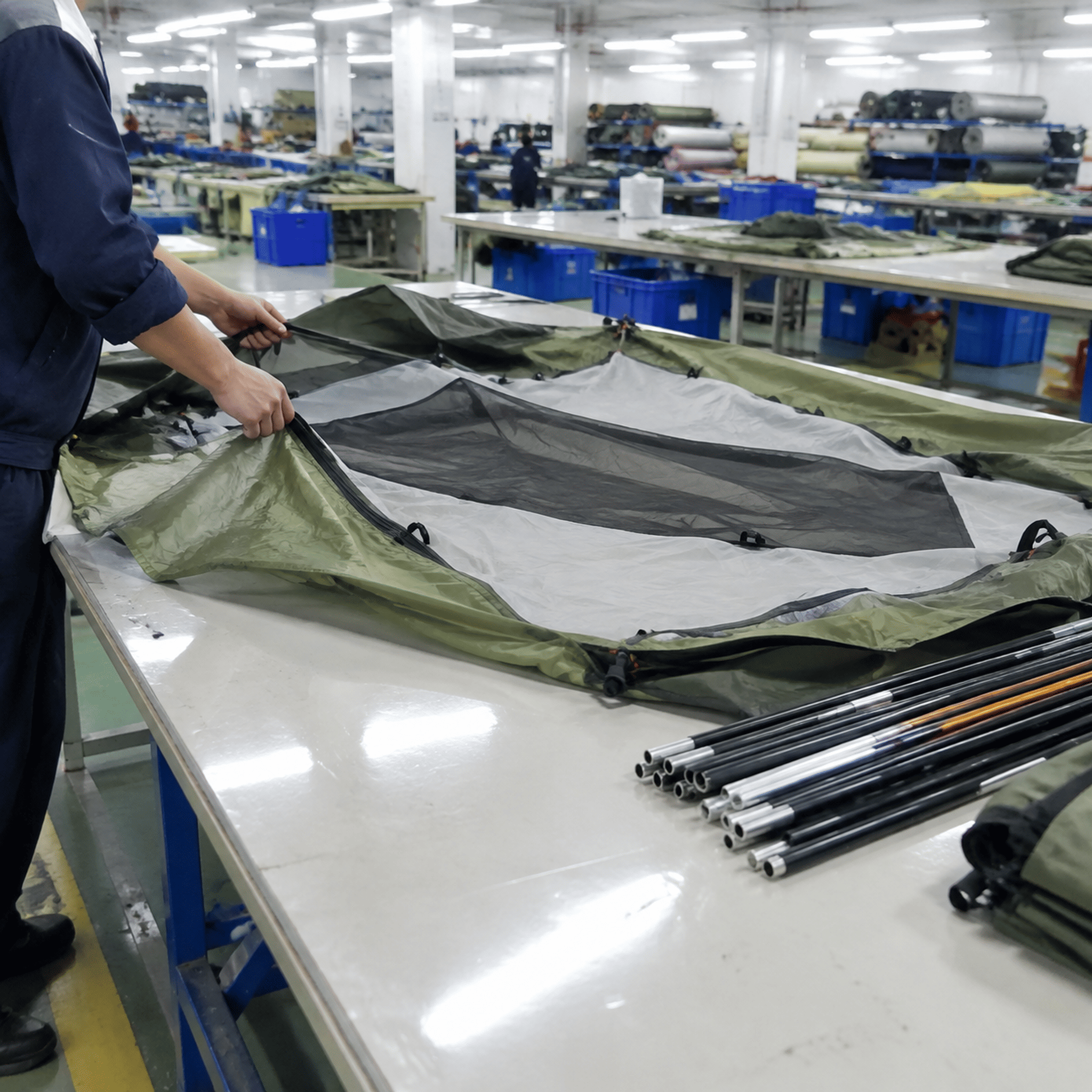
An attractive sample does not prove that mass production will match it.3 Samples may be made with selected materials, additional supervision, or small-batch processes. If camping equipment suppliers do not transfer the approved requirements to purchasing, cutting, sewing, assembly, finishing, and packing teams, quality can drift during a large order.
I look for a documented production-transfer process. Useful evidence may include a pre-production meeting, a sealed golden sample at the production line, an approved BOM, incoming material checks, calibrated equipment4, first-piece approval, and controls for subcontracted work. Buyers should verify that these controls apply to the contracted SKU and actual production batch.
Ask what happens before production begins
The buyer should not stop at the question, “Can you make this sample?” A more useful question is, “How will you make sure every department follows this approved version?”
I recommend requesting an explanation of the supplier’s pre-production process. Depending on the product and factory structure, the process may include:
- Confirming the final specification revision
- Reviewing the BOM with purchasing and production staff
- Sealing and tagging an approved golden sample
- Checking incoming material batches against approved requirements
- Producing and approving a first piece or pilot quantity
- Recording in-process inspection points
- Controlling design or material changes
- Reviewing packaging and labeling before final packing
A golden sample should have an identifiable status. I prefer a tag that records the SKU, approval date, revision, and signatures or other approval evidence. An unmarked showroom sample can be replaced or confused with another version.
Follow materials beyond the showroom
Many camping products depend on components supplied by other factories.5 Fabric, webbing, buckles, zippers, steel or aluminum tubing, foam, coatings, wheels, fasteners, and printed packaging may come from separate subcontractors.
I therefore ask camping equipment suppliers how they approve and monitor those sources. Useful questions include:
- Does the purchase order specify the same material as the approved BOM?
- How does the factory identify incoming batches?
- Which characteristics are checked at receiving?
- How are nonconforming materials isolated?
- Can a material substitution occur without written buyer approval?
- Does the factory retain production or material samples?
- How does it control externally processed coating, printing, or finishing?
Any technical figure should have a defined source and method. If a supplier claims a specific coating thickness, curing temperature, cutting tolerance, static-load result, fatigue-cycle result, or fill-power value, I would request the underlying specification and test record. I would not repeat the number as verified until a qualified party had checked the method, equipment, sample identity, and result.
The same caution applies to third-party claims. A supplier may mention a long operating history, an ISO management certificate, a social audit, or testing associated with TÜV or SGS. I treat those statements as information pending verification. I check the issuing body, holder name, site address, scope, validity period, report number, tested model, and tested materials before relying on them.
How Should Wholesalers Inspect Different Camping Products?
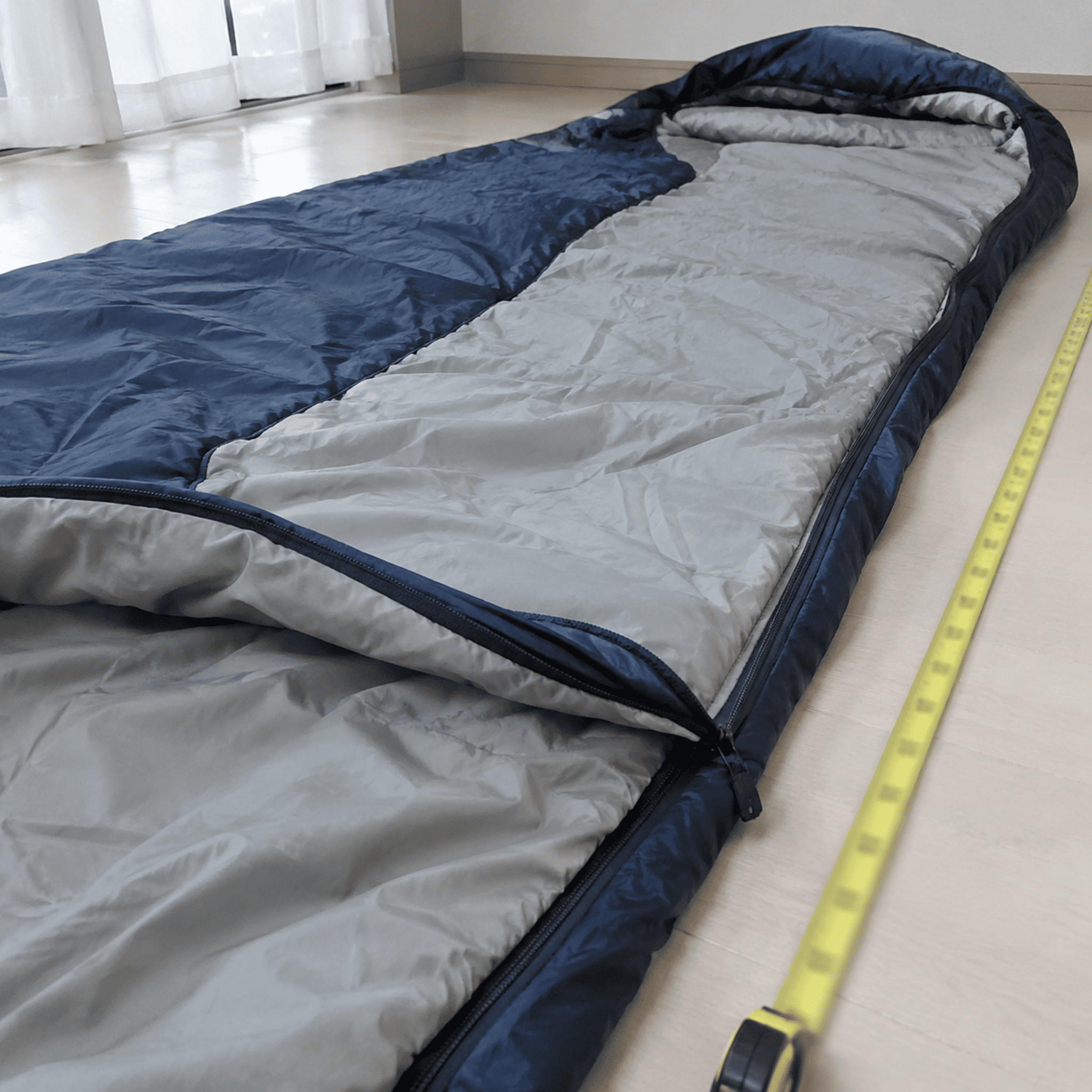
A generic final inspection can miss the defects that matter most.6 Tents need setup space and water-related checks. Sleeping bags need recovery time and construction measurements. Folding furniture needs assembly, stability, and functional evaluation. If an inspection starts too close to shipment, the buyer may find problems without having time to correct them.
I build the inspection plan around each product’s likely failure modes, setup requirements, test duration, and seasonal shipping cutoff. The plan should define sampling, workmanship criteria, measurements, functional checks, packaging verification, and reinspection rules. I also recommend leaving a correction buffer before shipment rather than treating inspection as a last-day formality.
Match checks to the product category
Different products require different inspection logic. A single checklist is unlikely to cover an entire camping range effectively.
| Product category | Possible failure modes | Inspection considerations |
|---|---|---|
| Tents and shelters | Missing parts, seam issues, incorrect dimensions, pole mismatch, coating or leakage concerns | Allow setup space; check components, dimensions, assembly, seams, and buyer-defined water-resistance methods |
| Sleeping bags | Incorrect filling, uneven distribution, zipper problems, wrong dimensions, poor recovery after compression | Allow unpacking and recovery time; verify construction, measurements, weight where specified, and zipper function |
| Folding chairs and tables | Instability, frame deformation, sharp edges, locking failure, loose fasteners | Check setup, folding action, stability, finish, joints, locks, and contract-defined loading tests |
| Camping cots | Fabric tension problems, frame mismatch, difficult assembly, connection failure | Assemble units fully; inspect tubes, joints, feet, fabric dimensions, and locking points |
| Folding wagons | Wheel problems, frame misalignment, handle failure, stitching defects | Check folding, steering, wheels, handle adjustment, frame, fabric body, and specified load behavior |
| Cooler and dry bags | Leakage, seam or weld defects, zipper issues, insulation inconsistency | Check construction and closure; use an agreed leakage or insulation evaluation method |
These examples are starting points rather than universal test standards. A qualified engineer, laboratory, inspection company, or compliance professional should determine application-specific methods when safety, performance, or regulatory obligations are involved.
Define sampling and acceptance clearly
Buyers sometimes write “AQL inspection required” without stating the sampling standard, inspection level, defect classification, or acceptance limits. That wording leaves too much open to interpretation.
ISO 2859-1 is often discussed in relation to acceptance sampling by attributes.7 However, the buyer must verify whether it is suitable for the contract and how it will be applied. The purchase agreement should define or reference:
- Lot size and lot formation
- Sampling standard and revision
- Inspection level
- Normal, tightened, or reduced inspection status if applicable
- Critical, major, and minor defect definitions
- Acceptance quality limits selected for the product
- Special sampling for functional or destructive tests
- Rules for failed inspections and reinspection
I do not recommend one AQL combination for every camping product. A cosmetic printing defect does not have the same significance as a structural failure, a sharp edge, a missing safety component, or an incorrect warning label.
Protect the seasonal deadline
Seasonality changes the cost of a quality failure.8 A late camping order can miss a promotion, retail launch, or peak-weather period even if the goods are eventually corrected.
As a practical planning recommendation, I often suggest scheduling pre-shipment inspection at least 10 working days before the shipping cutoff when the order and production plan allow it. This is not a universal rule. Complex products, large quantities, destructive tests, laboratory work, or major corrective action may require much more time.
The schedule should include:
- Initial inspection
- Defect analysis
- Corrective work
- Replacement production if needed
- Reinspection
- Final document review
- Booking and loading coordination
The real objective is not to inspect early for its own sake. The objective is to preserve a realistic recovery path.
How Can Buyers Verify Evidence from Camping Equipment Suppliers?
Certificates and laboratory reports can create false confidence when they cover a different company, factory, material, model, or production period. A valid report for premium virgin material does not validate a contracted SKU made from another blend. Generic documents cannot replace traceable evidence tied to the goods being purchased.
I verify whether each document matches the legal supplier, manufacturing site, contracted SKU, BOM material, test method, production period, and destination-market requirement. I also request retained samples or batch references where appropriate. If the connection between the report and the production lot cannot be demonstrated, I treat the evidence as incomplete.
Use a document-matching checklist
I use the following questions when reviewing supplier evidence:
- Who is named? Does the document identify the contracting company, factory, material producer, or another party?
- Which site is covered? Does the address match the production location?
- What product was tested? Is the model number the same as the contracted SKU?
- Which materials were tested? Do they match the approved BOM and production batch?
- Which method was used? Is the standard relevant to the product, market, and buyer requirement?
- When was it issued? Is the document current and applicable to present production?
- Who issued it? Can the buyer verify the laboratory, certification body, or audit organization?
- What is the scope? Does the conclusion cover the full product or only one component?
- Is there traceability? Can the supplier connect the tested sample to actual materials or production?
A report can be genuine and still be irrelevant. For example, a material aging report may accurately describe the submitted resin but provide no evidence about a finished wagon wheel made from a different blend.
Distinguish management certificates from product conformity
An ISO 9001 certificate may provide evidence that a named organization operates a quality management system within a stated scope. It does not, by itself, prove that every shipment conforms to the buyer’s specification.9
The same distinction applies to social audits and product tests:
| Evidence type | What it may support | What it does not prove alone |
|---|---|---|
| Quality management certificate | Management system at the named site and scope | Conformity of a specific shipment |
| Social compliance audit | Conditions reviewed during a stated audit | Product performance or material identity |
| Laboratory report10 | Results for submitted samples under stated methods | Ongoing conformity of untraced production |
| Pre-shipment inspection report | Findings from sampled finished goods | Every unit is defect-free |
| Golden sample | Approved appearance and construction reference | Materials remain unchanged without production controls |
Buyers should also confirm the applicability of standards such as EN 58111 for relevant outdoor seating or tables, REACH-related obligations12 for products placed on the EU market, and any destination-specific labeling or chemical requirements. I recommend qualified legal, testing, or compliance advice because applicability depends on the product, materials, market, and commercial role of each party.
How Should Wholesalers Score Camping Equipment Suppliers?
Supplier selection becomes subjective when a team relies on impressions from a trade show, showroom, or video call. Price can then dominate the decision because it is the easiest number to compare. A weighted scorecard gives quality control, development ability, communication, documentation, and seasonal reliability visible roles in the decision.
I recommend scoring camping equipment suppliers against evidence-based criteria that reflect the buyer’s business model. The weighting should match the order’s risks. Buyers can require supporting records, verify high-risk claims, and use a trial order or pilot run before placing a larger seasonal commitment.

Use weights that reflect commercial risk
The following scorecard is an example, not a universal formula:
| Evaluation area | Example weight | Evidence to review |
|---|---|---|
| Product and material control | 20% | BOM control, incoming checks, change approval |
| Production quality system | 20% | Pre-production process, in-process checks, calibration records |
| Product development capability | 15% | Sampling process, drawings, revision control, customization workflow |
| Inspection cooperation | 15% | Third-party access, corrective-action process, retained samples |
| Documentation and traceability | 10% | SKU-matched reports, batch records, document control |
| Communication and service | 10% | Response quality, issue escalation, specification confirmation |
| Capacity and seasonal planning | 5% | Production schedule, bottleneck analysis, subcontractor management |
| Commercial terms | 5% | Total landed implications, payment terms, warranty arrangements |
I would adjust the weights for the product. A new folding chair design may justify greater emphasis on structural review and development control. A repeated soft-goods order may place more weight on fabric consistency, color control, sewing quality, and replenishment reliability.
Verify claims in proportion to risk
Not every statement requires the same level of investigation. I use a risk-based approach:
- Low-risk claim: Confirm through documents or product samples.
- Medium-risk claim: Review records, conduct a video walkthrough, or obtain independent inspection.
- High-risk claim: Arrange an on-site audit, qualified technical review, or accredited laboratory testing where appropriate.
A trial order can also reveal whether the supplier controls communication and production consistently. However, the trial must use the intended materials and process. A specially supervised pilot does not prove that a larger order will receive the same treatment unless the production-transfer controls are documented.
Price remains important, but I compare it after aligning specifications. A higher quotation may include stronger materials, more complete packaging, more inspection, or better development support. A lower quotation may also be fully competitive because of efficient sourcing or manufacturing. The scorecard helps me ask which explanation is supported by evidence.
Frequently Asked Questions
Should I choose the camping equipment supplier with the best sample?
I would not choose a supplier from sample quality alone. I would confirm how the sample is identified, translated into a BOM, transferred to the production line, and matched during inspection. The best supplier is usually the one that can reproduce the approved standard consistently across the contracted quantity.
Which documents should I request from camping equipment suppliers?
I recommend requesting a business license or registration record, factory information, product specifications, BOM details, quality procedures, relevant test reports, and any claimed certificates. The exact list depends on the product and market. Every document should be checked for scope, validity, site, SKU, material, and issuing organization.
Is third-party inspection necessary for every wholesale order?
Third-party inspection is not automatically necessary for every order, but it can reduce risk for new suppliers, high-value shipments, complex products, or seasonal deadlines. I recommend defining the inspection scope in the purchase contract and selecting an inspection company with suitable product experience.
What is a golden sample?
A golden sample is the controlled product reference approved by the buyer and supplier. I prefer it to be sealed or otherwise protected, tagged with the SKU and revision, and available during production and inspection. It should work with written specifications and a BOM rather than replacing them.
How early should pre-shipment inspection take place?
I often use at least 10 working days before the shipping cutoff as a practical starting point, but I do not treat it as a fixed rule. The required buffer depends on order size, defect risk, test duration, correction capacity, reinspection needs, and the consequences of missing the seasonal window.
Conclusion
Choosing camping equipment suppliers requires more than comparing samples, certificates, and unit prices. I recommend aligning the RFQ first, controlling the approved sample and BOM, checking how requirements reach production, tailoring inspection to product failure modes, and verifying that every report matches the contracted SKU. A seasonal order also needs enough time for correction and reinspection. If you are evaluating bulk, OEM, ODM, or customized camping products, contact Ridgimax to discuss your specifications, quality expectations, and supplier evaluation requirements.
"[PDF] STANDARD BIDDING DOCUMENTS", https://thedocs.worldbank.org/en/doc/284441487883384455-0290022017/render/SBDWORKS.pdf. Public-procurement guidance emphasizes that clear and consistently stated technical specifications are necessary for bidders to interpret requirements on a comparable basis; although developed for formal procurement, the same principle is relevant to commercial RFQs. Evidence role: general_support; source type: government. Supports: Procurement guidance should establish that specifications need to be clear, complete, and consistently communicated so suppliers submit bids on a comparable basis.. Scope note: Public-procurement rules provide contextual support and may not govern private wholesale contracts. ↩
"6.5 Configuration Management - NASA", https://www.nasa.gov/reference/6-5-configuration-management/. Configuration-management guidance describes approved baselines and controlled change records as mechanisms for ensuring that participants work from the current authorized product definition; it supports the value of revision control but does not measure the reduction in disputes for camping-equipment orders. Evidence role: mechanism; source type: government. Supports: Configuration-management guidance should explain that approved baselines, change authorization, and revision records preserve a consistent definition of a product or system.. Scope note: The evidence establishes the control mechanism rather than a quantified commercial outcome. ↩
"Control (video game) - Wikipedia", https://en.wikipedia.org/wiki/Control_(video_game). Statistical quality-control guidance treats lot-level conclusions as dependent on representative sampling and defined acceptance procedures, so examination of one selected sample cannot establish conformity across mass production. Evidence role: mechanism; source type: research. Supports: Statistical quality guidance should show that conclusions about lot conformity require representative sampling or process evidence rather than observation of a single selected unit.. Scope note: Sampling theory supports the inference limitation but does not show that a particular supplier's production will differ from its sample. ↩
"Metrological Traceability: Frequently Asked Questions and NIST Policy", https://www.nist.gov/metrology/metrological-traceability. NIST metrology guidance explains that calibration and metrological traceability establish a documented relationship between measurement results and recognized references, thereby supporting confidence in measurements used for quality decisions. Evidence role: mechanism; source type: government. Supports: Metrology guidance should explain how calibration and traceability connect measurement results to recognized references and support confidence in inspection data.. Scope note: Calibration alone does not ensure that a test method, sampling plan, or acceptance criterion is appropriate. ↩
"Supply Chain Management - NIST", https://www.nist.gov/mep/supply-chain. Quality-management frameworks require organizations to control externally provided processes, products, and services when they affect conformity, supporting the need to monitor subcontracted materials and operations. Evidence role: mechanism; source type: institution. Supports: Quality-management guidance should establish that externally provided materials, components, and processes can affect conformity and therefore require proportionate supplier controls.. Scope note: The framework supports the general supply-chain principle but does not quantify outsourcing within the camping-equipment industry. ↩
"[PDF] Q9(R1) Quality Risk Management - FDA", https://www.fda.gov/media/167721/download. Risk-based quality guidance recommends aligning controls with identified failure modes and their consequences, supporting product-specific inspection plans rather than undifferentiated checklists. Evidence role: expert_consensus; source type: government. Supports: Risk-based quality guidance should establish that inspection and control activities are selected according to product risks, intended use, and the consequences of failure.. Scope note: General risk-management guidance does not prescribe the exact checks required for each camping-product category. ↩
"6.2.3.1. Choosing a Sampling Plan: MIL Standard 105D", https://www.itl.nist.gov/div898/handbook/pmc/section2/pmc231.htm. ISO describes ISO 2859-1 as establishing sampling schemes indexed by acceptance quality limit for lot-by-lot inspection by attributes. Evidence role: definition; source type: institution. Supports: The official standard description should confirm that ISO 2859-1 concerns sampling schemes indexed by acceptance quality limit for lot-by-lot inspection by attributes.. ↩
"A discrete optimization model for seasonal merchandise planning", https://www.academia.edu/3492057/A_discrete_optimization_model_for_seasonal_merchandise_planning. Research on seasonal and short-life-cycle merchandise identifies timing as a central inventory risk because delayed availability can cause lost sales during the demand window and residual stock or markdown exposure afterward. Evidence role: general_support; source type: paper. Supports: Operations-management research should show that products with short or seasonal selling windows face elevated lost-sales, leftover-inventory, or markdown risks when supply does not arrive at the appropriate time.. Scope note: The magnitude of the cost depends on the product, contract, demand pattern, and available alternative sales channels. ↩
"ISO and Quality Management | NIST", https://www.nist.gov/mep/iso-and-quality-management. ISO and accreditation guidance characterize ISO 9001 as a quality-management-system standard; certification attests to the assessed management system and scope, not to the conformity of every individual product or shipment. Evidence role: definition; source type: institution. Supports: Authoritative ISO or accreditation guidance should distinguish quality-management-system certification from product certification and shipment-specific conformity evidence.. ↩
"eCFR :: 49 CFR 40.97 -- What do laboratories report and how ...", https://www.ecfr.gov/current/title-49/subtitle-A/part-40/subpart-F/section-40.97. Laboratory-accreditation guidance requires test reports to identify the items tested and the results obtained; without representative sampling and traceability to production, those results do not establish continuing conformity of an entire manufacturing lot. Evidence role: definition; source type: institution. Supports: Laboratory guidance should establish that test reports identify the tested items and report results for those items, while broader conformity claims require an appropriate sampling and decision basis.. Scope note: A report may support broader conclusions when it is part of a valid certification, surveillance, or statistically representative sampling program. ↩
"EN 581-3:2026 Outdoor Tables Safety and Test Methods ...", https://standards.iteh.ai/catalog/standards/cen/145f3fc8-6168-4a96-8377-d6357c61a2a1/en-581-3-2026. The EN 581 series specifies requirements and test methods for relevant outdoor seating and tables, including aspects of safety, strength, and durability. Evidence role: definition; source type: institution. Supports: A standards-body source should identify the EN 581 series as applying to relevant outdoor seating and tables and describe its safety and performance scope.. Scope note: Applicability depends on the product's design, intended use, market, and the particular part and edition of the standard. ↩
"QnA Management - QA - European Union", https://qnapublic.echa.europa.eu/?topic=WFD%20-%20SCIP%20Database. European Chemicals Agency guidance explains that REACH can impose restrictions and information or notification duties for substances in articles, including certain substances of very high concern. Evidence role: definition; source type: government. Supports: EU or ECHA guidance should explain that REACH restrictions and information or notification duties can apply to substances contained in articles placed on the EU market.. Scope note: The duties that apply depend on the substance, concentration, tonnage, product classification, supply-chain role, and current EU rules. ↩


Leave a Reply